
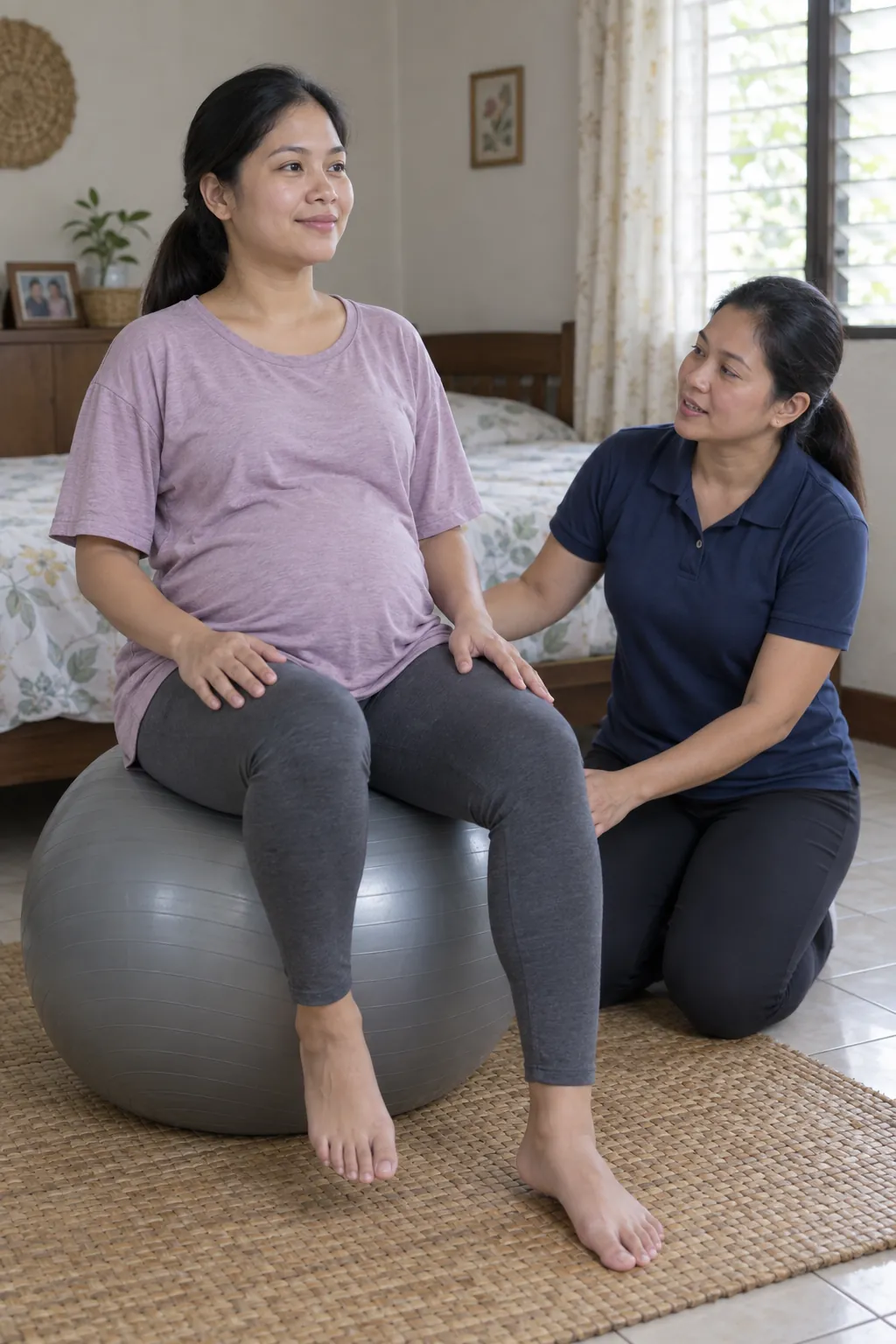
Generated illustration.
The first trimester is tiring in a way nobody warns you about. By the second, the tiredness often lifts, the bump starts to show, and a question arrives with it: is it safe to keep moving, and if so, how much?
For most healthy pregnancies the answer is yes, and more than people expect. The American College of Obstetricians and Gynecologists (ACOG) recommends around 150 minutes of moderate activity a week for a pregnancy without complications. The World Health Organization gives the same figure. That is about 20 minutes a day, or half an hour on five days, at a pace where you can talk but would rather not sing.
Your OB-GYN decides, before anyone else
Everything below assumes your doctor has said exercise is fine. Ask at your next check-up, and bring the list of moves in this article so the answer is specific.
Some pregnancies are not suited to exercise at all, or only to walking. Doctors look for things like a placenta that sits low, bleeding, a history of early labour, twins or more, high blood pressure, and certain heart and lung conditions. None of these are yours to judge from home. If the doctor says rest, rest, and if a coach ever suggests otherwise, find a different coach.
Nothing in this article is medical advice. It is a practical guide for a pregnancy your doctor has already cleared.
How hard is hard enough
Forget heart-rate zones. The simplest measure, and the one doctors often give, is the talk test: during the effort you should still be able to hold a conversation. Short breaths between phrases are fine. Gasping is not.
The heat changes this in the Philippines. Body temperature matters more in pregnancy, and a humid afternoon in a closed room makes a gentle session harder than it looks. Train early, with the electric fan on and water beside you, and stop sooner on hot days than you would on cool ones.
Six moves that need a ball, a chair and a wall
Each of these works in most trimesters. Move slowly, breathe out on the effort, and skip anything that feels wrong on the day.
Seated march on an exercise ball. Sit tall on the ball with feet flat and wide. Lift one foot a few centimetres, set it down, then the other. It trains balance and the deep stomach muscles without lying down. Keep a hand on a chair or a partner close by, because balance shifts as the bump grows.
Supported wall squat. Stand with your back flat against a wall and feet a step forward. Slide down only a little, into a shallow bend, then press back up. This keeps the legs strong for the months of carrying ahead, and the wall does the balancing.
Cat-cow on hands and knees. Kneel on a mat with hands under the shoulders. Slowly round the back as you breathe out, then let it return to flat as you breathe in. Many women find it eases the ache in the lower back, and it takes the weight of the bump off the spine for a moment.
Wall push-up. Hands on the wall at shoulder height, body straight, bend the elbows and push away. Arms and upper back take a beating from lifting a newborn, so strength here pays later.
Side-lying leg lift. Lie on your side with a pillow under the head and one between the knees if that helps. Lift the top leg slowly and lower it. It works the hip muscles that hold the pelvis steady when you walk.
Walking. The least exciting move on the list and the one most doctors recommend first. The subdivision loop at six in the morning, the mall corridors on a rainy day. Wear shoes that support the arch, since feet often swell and flatten in the later months.
What to skip
Lying flat on your back for long stretches after the first trimester. The weight of the uterus can press on a large vein and leave some women dizzy. Prop yourself up with pillows instead.
Anything with a real chance of a fall or a blow to the stomach: basketball, badminton at speed, cycling on the road, anything on a slippery tiled floor in socks. Deep twists, heavy lifting from the floor, and holding your breath while straining also come off the list.
Hot rooms and long sessions in the middle of the day, for the reason above.
Signs that mean stop and call your doctor
Stop straight away, and call, if you notice any of these during or after exercise: bleeding or fluid from the vagina, regular painful tightening of the stomach, chest pain, a headache that will not go, dizziness or feeling faint, calf pain or swelling, or muscle weakness that throws off your balance. These are the warning signs ACOG lists. Call too if the baby is moving much less than usual. None of them are something to push through.
After the baby arrives
Birth is recovery, whatever the route. ACOG’s advice is to return gradually, as soon as it is medically safe, and that point differs from one birth to the next: a caesarean usually needs longer. Anything beyond gentle walking waits for your doctor’s go-ahead at the postpartum check-up. The same muscles trained in pregnancy are the ones to rebuild first: gentle bridges, breathing work for the deep stomach, standing band rows for a back that now carries a baby all day.
Our pre- and post-natal fitness page explains how Fit Bud runs these sessions at home, always inside the limits your doctor sets. You can also see what the moves above look like in the seniors, pregnancy and after-birth gallery, which shows them in ordinary Filipino homes with a coach close by.
Having someone watch
Most of these moves are simple, and most women do them safely alone. A coach earns their place in two situations: when you have never trained before and want someone to check the form, and when the pregnancy is tiring enough that a plan written for the week makes it more likely to happen at all. If that sounds useful, tell us your town and your due date and a coach will reply with a few questions first.