Generated illustration.
A workout is one session of planned exercise. A workout plan is the set of sessions you repeat for a few weeks, written down so that each one builds on the last. The difference between the two is the reason most people stop: a single hard workout feels like progress, but without a plan the next one is a guess, and guesses get skipped.
This guide gives you a free plan to start with, explains every part of it, and then shows you how a coach decides what goes into one, so you can change it yourself when it stops fitting.
What every workout needs
A session has three parts, in this order.
- A warm-up of five to eight minutes. Walking on the spot, arm circles, bodyweight squats, leg swings. The point is a warmer body and joints that have moved through their range before they are loaded. Our guide to stretching before a workout explains why this replaces the old static stretches.
- The main work. Strength moves, a run, a court session, or a mix. This is the part the plan is about.
- A finish of three to five minutes. Slower walking, easy breathing, a few gentle stretches for whatever feels tight. Our guide to cool down exercises gives a routine for it.
Skip the first part and the first set feels bad. Skip the last and you walk out with a racing heart and a sweaty shirt into a jeepney. Neither is dangerous for most people, but both make the next session less likely.
How many days
The World Health Organization’s 2020 guidelines ask adults for 150 to 300 minutes of moderate aerobic activity a week, or 75 to 150 minutes of vigorous activity, and muscle-strengthening work for all the major muscle groups on two or more days. That is the target to grow into. It is not the starting point.
For a beginner, three sessions a week with a rest day between them is enough to get stronger and to build the habit. Two is still worthwhile. One is better than none, though progress will be slow.
The free plan
This is a full-body plan for someone who has not trained before, or has not trained for a while. It needs a mat, a sturdy chair, and a pair of light dumbbells or a resistance band if you have them. If you have neither, every move has a bodyweight version, and our guide to strength training at home with no equipment teaches them.
| Day | Session | What it is |
|---|---|---|
| Monday | Strength A | The six moves below, 2 sets each |
| Tuesday | Walk | 20 to 30 minutes at a pace where you can still talk |
| Wednesday | Strength B | The same six moves, 2 sets each, a little slower on the lowering |
| Thursday | Rest or walk | Your choice |
| Friday | Strength C | The six moves, 3 sets if the first two sessions felt fine |
| Saturday | Something you enjoy | Basketball at the court, a long walk, swimming, a bike ride |
| Sunday | Rest | A full day off |
The six moves
Do them in this order. Ten to twelve repetitions each, rest about a minute between moves, and go round the whole list for each set.
- Squat. Feet a little wider than the hips, sit back and down as if reaching for a chair, stand up. Hold a dumbbell at the chest once the bodyweight version is easy.
- Push-up. Hands on a table or counter to start, then a bench, then the floor. One straight line from head to heels. The chest workout guide shows the progression.
- Row. A band anchored to a door handle or a dumbbell in one hand with the other hand on the chair. Pull the elbow back past the ribs.
- Reverse lunge. Step one foot back, lower the back knee towards the floor, push back up. Hold a wall if balance is shaky. Our lunges guide covers the form in detail.
- Glute bridge. On your back, knees bent, push the hips up until the body is straight from shoulders to knees. The glute bridge guide explains what it does.
- Plank. From the knees or the forearms, ten to twenty seconds, three times. Judged by the straight line, never by the clock, as our plank guide puts it.
With the warm-up and the finish, a session takes 30 to 40 minutes.
Sets, reps and rest, in plain words
A rep is one full movement, down and up. A set is a group of reps done without stopping. Rest is the pause between sets.
For a beginner learning the moves, 8 to 12 reps per set and 2 or 3 sets per move is the range most coaching bodies recommend, with a minute or two of rest. The American College of Sports Medicine’s position stand on resistance training gives the same range for people new to it. Heavier weights for fewer reps, and lighter weights for more, both have their place later. At the start, the goal is clean repetitions you can count on.
The last two reps of a set should feel hard. If every rep is easy, the move needs more load or a harder version. If your form changes before the eighth rep, it needs less.
How to make the plan progress
Repeating the same sessions for months is the second reason people stop, because the body adapts and the results flatten. A plan should get a little harder most weeks. In order of preference:
- Add a rep or two to each set.
- Add a set.
- Slow the lowering part of each move to three or four seconds.
- Move to the harder version: floor push-ups instead of incline, a dumbbell on the squat.
- Add weight.
Change one thing at a time and write down what you did. Our guide to progressive overload is the long version of this section.
The five rules a coach uses to build a plan
When Fit Bud’s coaches write a plan at the end of a first session, these are the decisions behind it. You can make them for yourself.
- Start with the week you actually have. Three evenings you can keep beat five you cannot. The plan goes around work, the commute and the household.
- Cover the whole body each time. A push, a pull, a squat, a hinge, a carry and some trunk work. Split routines that train one body part a day suit people training five or six days a week. At three days a week, full-body sessions do more.
- Pick moves you can do well today. The harder version is always available next month.
- Leave something in the tank. A session you finish feeling you could do a little more is one you will come back to. The plan progresses by design, so you do not need to empty yourself to earn it.
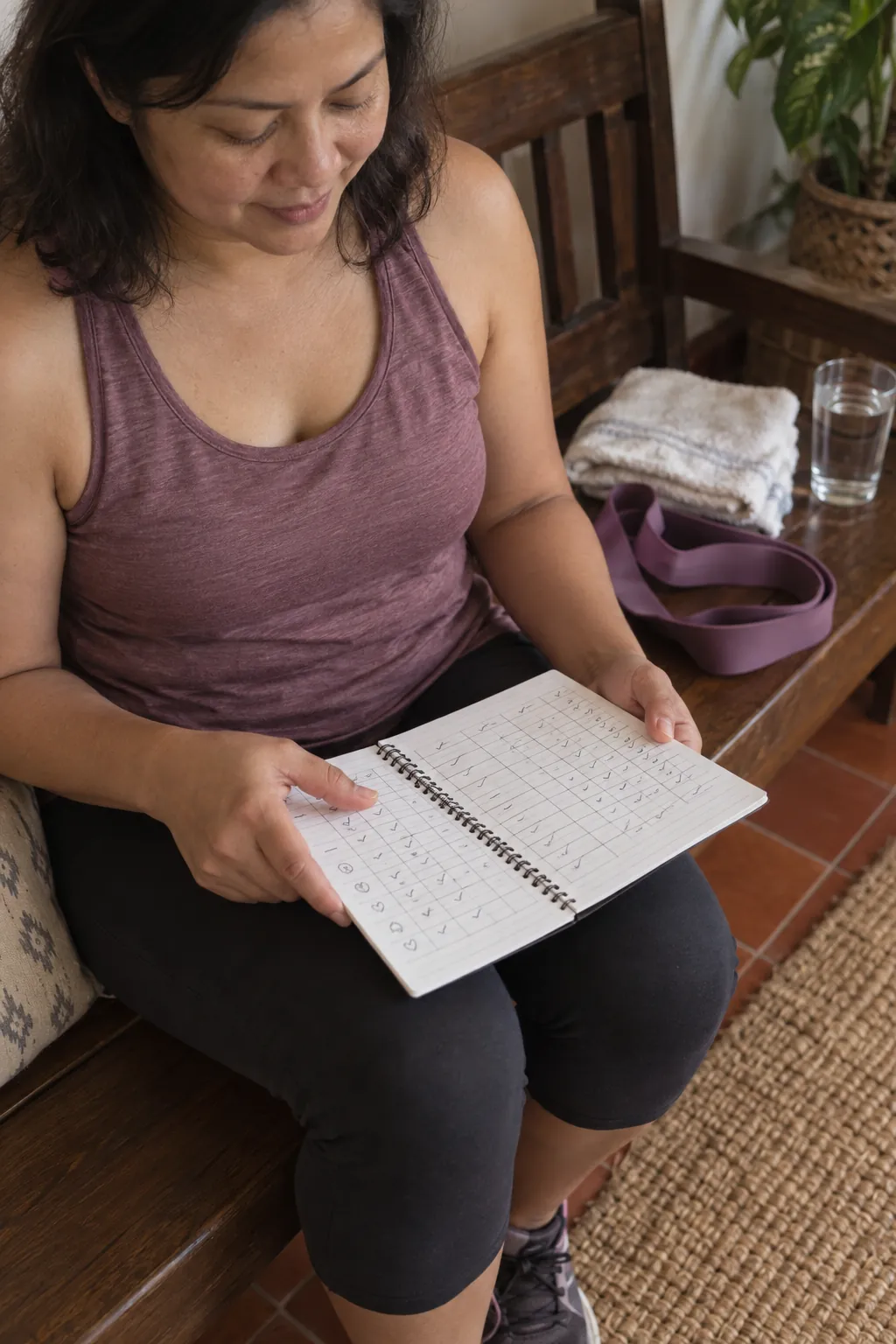
- Write it down and tick it off. A notebook or a phone note with the date, the moves, the weight and the reps. Two weeks of notes tell you when to progress.
Fitting it to the Philippines
Early morning and after dark are the cool hours. A session at 2 pm in a room without air conditioning is possible but unpleasant, and in the hot months it is worth moving it. Our guide to training in the heat covers water, clothing and the signs to stop.
If the walk days are the problem because of traffic or weather, a covered court, a mall before the shops open, or marching on the spot in front of the fan all count.
Common mistakes
- Starting with six days a week. Three kept beats six abandoned.
- Doing only the moves you like, usually arms and abs, and skipping legs and back.
- Copying a programme written for someone who already trains. The plan above is where that person started too.
- Changing the plan every week because something online looked better. Give one plan four to six weeks.
- Never writing anything down.
Who should check first
If you have a heart condition, high blood pressure that is not controlled, diabetes, a recent operation, or you are pregnant, talk to your doctor before starting. If a joint hurts sharply during a move, stop that move and, if the pain continues, see a doctor or a physiotherapist rather than training through it. Muscle soreness a day or two after a session is normal for the first few weeks and eases on its own.
Questions people ask
What is a good workout plan for a beginner? Three full-body strength sessions a week with a rest day between, each covering a squat, a push, a pull, a lunge or hinge, and some trunk work, plus walking on the other days. The plan above is exactly that.
How many days a week should I work out? Two or three strength sessions a week is enough to start. The WHO target for adults is strength work on two or more days and 150 to 300 minutes of moderate activity in total, which you can build towards over a few months.
How long should a workout be? Thirty to forty-five minutes including the warm-up is plenty for a beginner. Longer sessions add fatigue faster than they add results.
Can I work out every day? You can be active every day. Training the same muscles hard every day leaves no time for them to recover and get stronger, so alternate strength days with walks, sport or rest.
Do I need a gym? No. The plan above works in a sala with a chair and a mat. A gym adds heavier weights and machines, which matter later. Our guide to starting at the gym covers that when you are ready.
Getting a plan written for you
The plan above is a sensible start for most healthy adults. A plan written for you takes account of your week, your injuries, your floor space and what you already own, and a coach watching the first few sessions catches the form faults you cannot feel. Fit Bud’s beginner fitness program starts there, at your home, condo gym or clubhouse, and every first session ends with a written plan you keep. Outside the in-person areas, online coaching does the same by video call. To start, tell us your town and your goal.
Sources
World Health Organization, Guidelines on physical activity and sedentary behaviour, 2020: 150 to 300 minutes of moderate or 75 to 150 minutes of vigorous aerobic activity a week for adults, and muscle-strengthening activity on two or more days. American College of Sports Medicine, Progression Models in Resistance Training for Healthy Adults, position stand, 2009: 8 to 12 repetitions and 2 to 3 sets per exercise for novices, with 2 to 3 training days a week.