Generated illustration.
Most people who buy a pair of dumbbells use them for a fortnight, then they end up holding the door open. The weights were never the problem. What was missing was a short plan that covers the whole body and tells you when to make it harder.
This is that plan. It needs one pair of dumbbells, a sturdy chair or bench, and about two by two metres of floor.
How heavy to start
Pick a weight you can lift for 12 slow repetitions of the goblet squat below, with the last two feeling hard but clean. For many beginners that is somewhere between 3 and 8 kilograms per dumbbell, but treat any number as a guess and let the squat decide.
If you can only buy one pair, lean light. A weight that is too easy can be made harder with slower lowering and more repetitions. A weight that is too heavy just teaches bad form.
The six moves
Do them in this order, 10 to 12 repetitions each, resting about a minute between moves. Go round twice at first and three times once that feels easy. With a warm-up it takes 25 to 35 minutes; our guide to stretching before a workout sets out what that warm-up should be.
Goblet squat. Hold one dumbbell upright against your chest by the top end. Feet shoulder-width, sit between your heels, chest up, and stand. The weight in front keeps you upright, which is why it is easier to learn than a squat with the weights at your sides.
Romanian deadlift. A dumbbell in each hand in front of your thighs. Soft knees, push your hips back and let the weights slide down the front of your legs to just below the knee, back flat, then stand tall. It trains the back of the legs and the glutes, the muscles that do the work when you pick a child or a sack of rice off the floor.
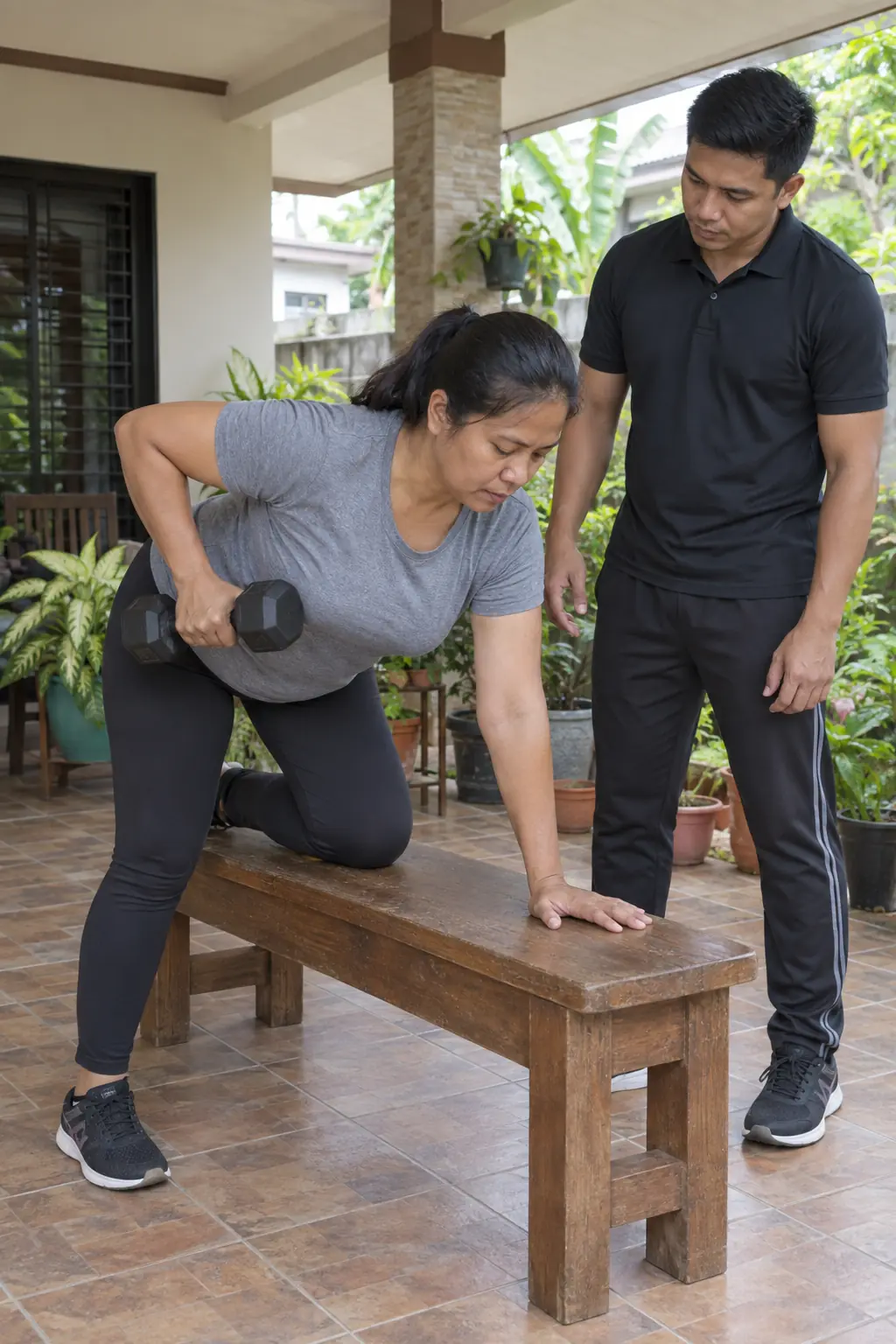
Single-arm row. One hand and one knee on the chair or bench, the other foot on the floor, back flat. Pull the dumbbell up until the elbow passes your ribs, then lower slowly. Both sides.
Floor press. Lie on your back with knees bent, a dumbbell in each hand above the chest. Lower until your upper arms touch the floor, then press up. The floor stops the elbows going too deep, so it is kinder to the shoulders than a bench press for a beginner.
Seated overhead press. Sit tall on the chair, dumbbells at shoulder height, and press them up until the arms are straight beside your ears. Sitting takes the lower back out of the movement.
Reverse lunge. A dumbbell in each hand at your sides. Step one foot back, lower the back knee towards the floor, and push back up through the front heel. Alternate legs.
To finish, pick up both dumbbells and walk 20 to 30 metres, three times. Our guide to the farmers carry explains the posture and how heavy to go.
The exercise form gallery shows most of these from the side, with a coach beside the client, including the Romanian deadlift, the single-arm row and the seated press. If you have a band rather than dumbbells, the resistance band gallery shows rows, presses, squats and bridges done with one instead.
How to make it harder
When every set of every move reaches 12 clean repetitions, it is time to progress. This is progressive overload, the principle behind every programme that keeps working. In order of preference:
Slow the lowering to three or four seconds. It costs nothing and it is harder than it sounds.
Add a third round.
Buy the next pair up, usually 2 kilograms heavier.
Keep a note of what you did each session: the weight, the repetitions, how hard it felt. Two weeks of notes tell you more than any feeling on the day.
How often
Two or three times a week, with a rest day between sessions, is plenty for a beginner. Muscles get stronger in the days between workouts, and training the same muscles every day leaves no time for that.
Common mistakes
Rounding the back on the Romanian deadlift or the row. If the back will not stay flat, the weight is too heavy or the hips are not bending enough.
Rushing. A repetition that takes one second is mostly momentum. Two seconds up and two or three down is a good rhythm.
Holding your breath. Breathe out on the effort, in on the way back.
For the pressing moves in particular, our chest workout and triceps workout guides go through the elbow and shoulder-blade position in detail.
When a coach helps
Most people can learn these moves alone from a mirror and patience. A coach earns their place for the Romanian deadlift and the row, where a rounded back is hard to feel and easy to see, and for the plan itself, so progress keeps happening after the first month. Fit Bud’s strength training sessions use dumbbells, bands and kettlebells at your home, condo gym or clubhouse, with the coach bringing equipment as agreed. If you would like your form checked in your own living room, tell us your town and your goal.