
Generated illustration.
Every chest exercise is the same movement: pushing something away from the front of your body. What changes is the angle, the load and whether you are moving a weight or moving yourself. Once you see that, a chest workout stops being a list of exercises to copy and becomes a few choices you can make for yourself.
This guide gives one workout for home and one for the gym, explains what each move trains, and spends most of its words on form, because a chest workout done with the shoulders doing the work builds sore shoulders rather than a chest.
What the chest is, and what works it
The pectoralis major is the big fan-shaped muscle across the front of the ribs. Its upper fibres run from the collarbone, and its middle and lower fibres from the breastbone. All of them pull the arm across and forward. Pressing at an incline leans the work towards the upper fibres; a flat press or a push-up spreads it across the whole muscle; a decline or a dip leans towards the lower fibres.
Underneath sits the pectoralis minor, and around the side of the ribs the serratus anterior, which pushes the shoulder blade forward at the top of a push-up. The front of the shoulder and the triceps help in every press, which is why a chest workout leaves them tired too, and why our triceps workout is usually trained on the same day.
The form that applies to every press
- Set the shoulder blades first. Pull them gently down and together before the first repetition, and keep them there. On a bench or the floor, this means the upper back is pressed into the surface, and the chest sits slightly up.
- Elbows at about 45 degrees to the body, between tucked in and flared out wide. Flaring to 90 degrees loads the front of the shoulder.
- Wrists over elbows at the bottom. Hands a little wider than the shoulders usually puts them there.
- Full range, under control. Lower until the upper arms are level with the body, or the chest is just above the floor, then press to straight arms without bouncing.
- Feet planted. In a push-up, squeeze the glutes so the hips neither sag nor pike. On a bench, both feet flat on the floor.
- Breathe. In on the way down, out on the way up.
The home chest workout
Needs a mat, a sturdy table or bench, and a band or a pair of dumbbells if you have them. Two or three sets of each, 8 to 12 repetitions, about a minute of rest between.
| Move | How | What it trains |
|---|---|---|
| Push-up at your level | Hands on a table, then a bench, then the floor as you get stronger. One straight line from head to heels | Whole chest, front of shoulders, triceps, trunk |
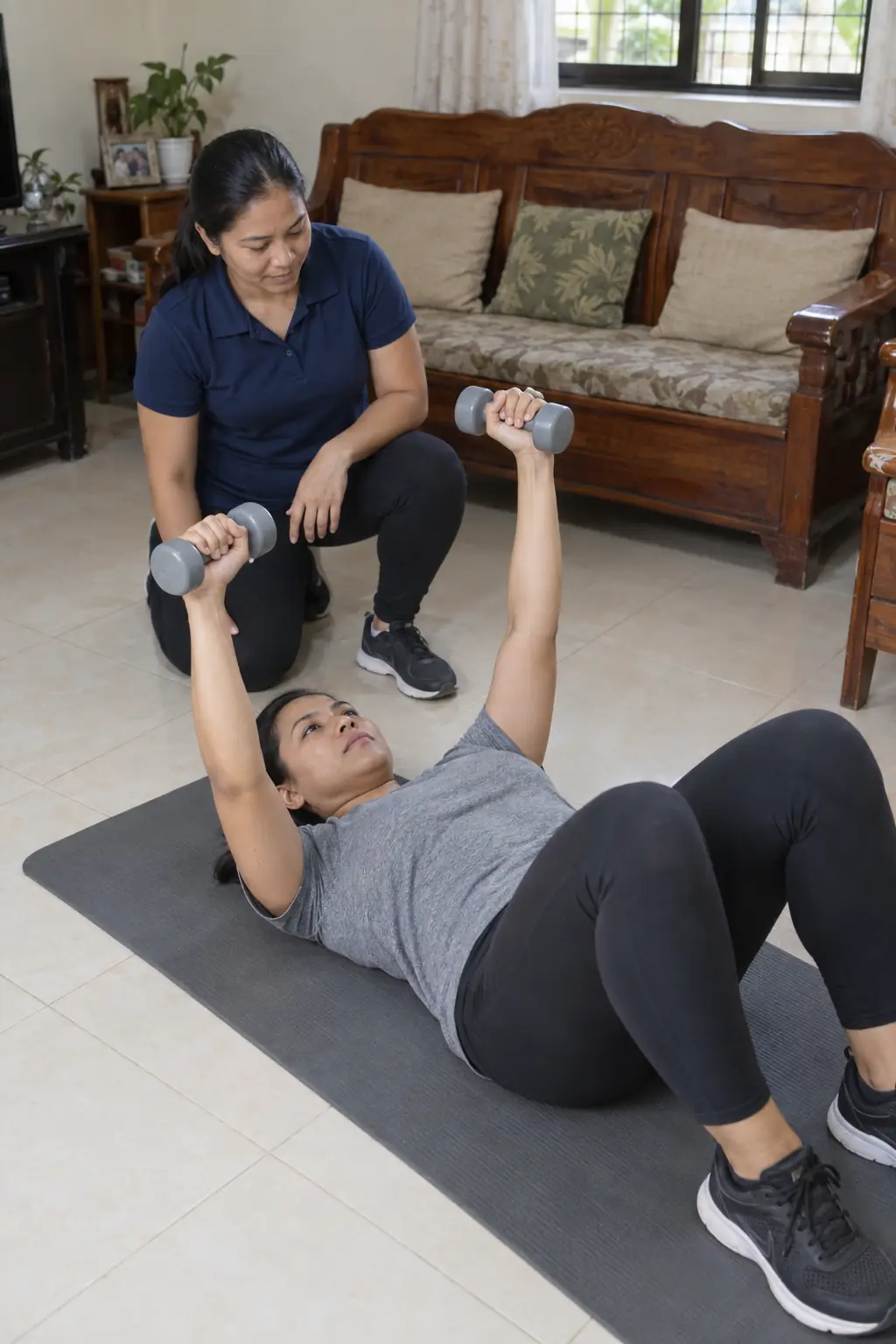
| Dumbbell floor press | On your back, knees bent, press two dumbbells from the floor beside the chest to straight arms. The floor stops the elbows, which protects the shoulders | Chest and triceps with load |
| Band chest press | Band around the upper back, handles at the chest, press straight forward. Step forward to make it harder | Chest, with the resistance hardest at the top |
| Band or dumbbell fly | On your back, arms wide with a slight bend, bring the hands together above the chest and lower slowly | The squeeze across the chest, with little help from the triceps |
| Finisher: slow push-ups | As many as you can with a three-second lowering, from the knees if needed | Control under fatigue |
The exercise form gallery shows the push-up, the incline push-up and the floor press with a coach beside each one, and the resistance band gallery shows the band press.
Push-up progression
Most beginners cannot do a clean push-up from the floor, and that is normal. Start with the hands on the kitchen counter. When 12 are easy, move to a dining table, then a sturdy bench, then the floor from the knees, then the floor. Each step down adds load. Once floor push-ups reach 15, raise the feet on a step for a harder version.
The gym chest workout
Same sets and reps. Choose a weight where the last two repetitions of each set are hard but the form does not change.
| Move | Why it is here | Notes |
|---|---|---|
| Dumbbell bench press, flat | The main lift. Dumbbells let each arm work alone and can be dropped safely to the sides if a set fails, so you do not need a spotter | Shoulder blades set, elbows at 45 degrees |
| Incline dumbbell press | Leans the work to the upper chest | Bench at 30 degrees, not steeper, or the shoulders take over |
| Chest press machine | Holds you in a fixed path, which is useful while learning to brace | Set the handles at mid-chest height |
| Cable fly or pec deck | The squeeze across the chest without the triceps helping | Slight bend in the elbows, slow return |
| Assisted dip or bench dip | Lower chest and triceps | Lean forward slightly for chest; keep the shoulders from dropping below the elbows |
A barbell bench press is the classic, and it is a fine lift once you have learned the dumbbell version. Use it with a spotter or with the safety bars set, because a failed barbell bench press with nobody there is one of the few ways to get badly hurt in a gym. Our guide to starting at the gym covers the room, the machines and the manners.
How often, and how to progress
Twice a week is a good target. A 2016 review of the research by Schoenfeld and colleagues found that training a muscle twice a week built more muscle than once, so a chest session on Monday and another on Thursday does more than one long one. Each session needs only three or four chest moves.
Progress one thing at a time: a repetition, then a set, then a slower lowering, then a heavier weight or a harder push-up level. Our guide to progressive overload covers how to tell when.
Balance the pushing with pulling. For every chest set, do a set of rows or pulldowns somewhere in the week. A chest trained without a back rounds the shoulders forward, and that posture is what most people are trying to get rid of. The dumbbell workout at home pairs a floor press with a row for exactly this reason.
Common mistakes
- Elbows flared straight out to the sides. It feels strong and it hurts shoulders over time.
- Half repetitions, especially on the push-up. Lower all the way.
- Hips sagging in the push-up, so the lower back does the holding.
- Bouncing the dumbbells or bar off the chest.
- Only flat pressing, and never any incline or fly work.
- Training chest four times a week and back never.
- Going heavy on a barbell alone without safety bars.
Shoulders and wrists
A chest workout should be felt across the chest and in the back of the arms the next day. If it is felt as a sharp pain at the front or top of the shoulder during the set, stop that move. Try a narrower hand position, a floor press instead of a bench press, or a higher incline on the push-up. If the pain comes back each session, see a doctor or a physiotherapist before continuing. Wrist discomfort in push-ups usually eases with the hands turned slightly out, or with push-up handles or dumbbells on the floor to grip.
Questions people ask
What is the best chest workout? One with a press at a flat or slight incline angle, a second press or a push-up at a different angle, and a fly or squeeze movement, done twice a week with a weight or a level where the last two reps are hard. The two workouts above are built on that.
Can you build your chest at home? Yes. Push-ups through the full progression, a floor press and a band press cover the same movement the gym does. The gym adds heavier loads, which matter later.
How many chest exercises should I do in one workout? Three or four. More than that adds fatigue without adding much.
How many times a week should I train chest? Twice, with at least two days between sessions, is what most of the research supports for building muscle.
Why don’t I feel my chest when I press? Usually because the shoulder blades are not set, so the shoulders roll forward and do the work. Pull them down and together before the first rep, and slow the lowering.
Having your press checked
Flared elbows and loose shoulder blades are the two faults you cannot feel until they hurt, and both are visible from the side. Fit Bud’s strength training sessions happen at your home, condo gym or a gym you already pay for, and pressing is part of the movement screen at every first session. To have yours checked, tell us your town and your goal.
Sources
American College of Sports Medicine, Progression Models in Resistance Training for Healthy Adults, position stand, 2009: 8 to 12 repetitions and 2 to 3 sets for novices. Schoenfeld, Ogborn and Krieger, “Effects of Resistance Training Frequency on Measures of Muscle Hypertrophy: A Systematic Review and Meta-Analysis”, Sports Medicine, 2016: training a muscle group twice a week produced greater muscle growth than once a week.