
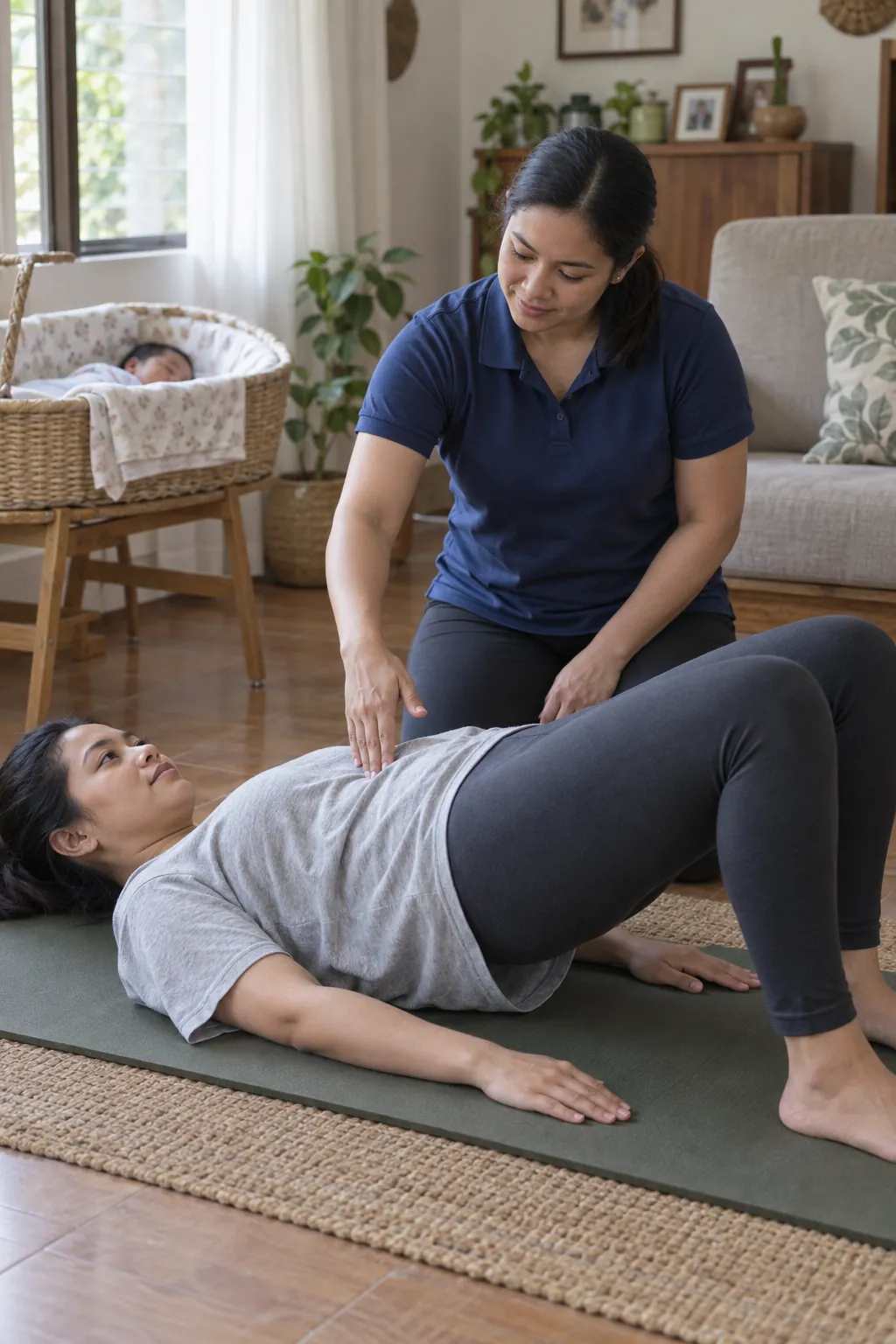
Generated illustration.
A few weeks after the birth, many mothers notice that the middle of the tummy still domes when they sit up, or that there is a soft line running down from the belly button. Often it is diastasis recti: the two long stomach muscles that run down the front have moved apart to make room for the baby, and have not yet come back together.
It is common, and usually it gets better. The NHS explains that the muscles commonly separate during pregnancy, usually by about two finger widths, and that the gap will usually go back to normal by the time the baby is eight weeks old. Cleveland Clinic’s patient guide puts it at about six in ten women after childbirth. For some the gap stays, and that is where the right exercises, and the right people, come in.
Nothing here is medical advice. It is a guide to what health services recommend, for mothers whose doctor has cleared them to move.
Check the gap at home
The NHS describes a simple check:
- Lie on your back with your knees bent and your feet flat on the floor.
- Lift your shoulders off the floor slightly and look down at your tummy.
- With your fingertips, feel between the edges of the muscles, above and below the belly button.
- Count how many fingers fit into the gap.
Do it every week or two so you can see whether the gap is getting smaller. Cleveland Clinic advises talking to your doctor if you feel a gap of two or more finger widths, and the NHS says to see a doctor if the gap is still obvious eight weeks after the birth, because of the risk of back problems. Tummy pain or discomfort is worth mentioning at the same visit.
Gentle exercises to start with
The first exercises are quiet ones. Nobody watching would call them a workout, and that is the point: they wake up the deep muscles that hold the tummy in without pushing the gap wider.
Deep stomach squeeze, lying on your side. This is the exercise the NHS gives. Lie on your side with your knees slightly bent and let your tummy relax. Breathe in gently. As you breathe out, draw in the lower part of your stomach like a corset, narrowing your waist, and squeeze your pelvic floor at the same time. Hold for a count of ten while breathing normally, then let go. Repeat up to ten times.
Pelvic floor squeezes. The NHS pairs deep stomach work with pelvic floor exercises, and says the two together can help reduce the gap. Squeeze and draw in as if holding in wind and stopping the flow of urine at the same time, hold, then let go. They can be done lying down, sitting while feeding, or standing at the sink. Our guide to the kegel exercise shows how to find the right muscles and a routine to build on.
Walking. The American College of Obstetricians and Gynecologists (ACOG) calls walking a great way to start again after birth, and suggests building towards 20 to 30 minutes a day. Stand tall behind the stroller rather than leaning on it.
Gentle bridge, once the squeezes feel easy and your doctor or physio agrees. Lie on your back with your knees bent, breathe out, draw the lower tummy in, and lift the hips only as high as is comfortable. Lower slowly. If the tummy domes or bulges along the middle as you lift, the move is too much for now.
Standing tall. The NHS also says posture matters. A newborn pulls you forward all day, during feeds, carrying and bathing, so a moment to stand up straight and breathe is part of the work.
What to leave for later
The exercises people usually reach for first are the ones to avoid at the start. The NHS lists sit-ups, planks and high-impact exercise. Cleveland Clinic adds crunches of any kind, downward dog and double leg lifts. All of these push the tummy outward against the gap.
The same goes for the everyday versions. The NHS advises against straining on the toilet and heavy lifting. Sitting straight up from lying down is a small sit-up, so roll onto your side and push up with your arms instead.
When a doctor or physio takes over
If the gap has not closed by around eight weeks, or it hurts, the NHS says a doctor can refer you to a physiotherapist for exercises specific to you. A pelvic health physiotherapist is the right person to measure the gap properly and set the plan. Cleveland Clinic describes surgery as something considered in particular cases, such as a hernia at the belly button, rather than the first step.
Where a coach fits
A coach does not diagnose or treat diastasis recti. Fit Bud’s pre- and post-natal fitness sessions start only with your doctor’s clearance in writing, and if your doctor or physio has diagnosed a gap, the coach works inside their guidance. What a coach adds is the rest of the body: building back the strength for lifting a baby, a car seat and a laundry basket, at home, around feeds and naps.
For what these moves look like in an ordinary home, see the pregnancy and after-birth gallery, and for the months before the birth, our guide to exercise for pregnant women at home. If you would like a coach once you are cleared, tell us your town and how many weeks since the birth.