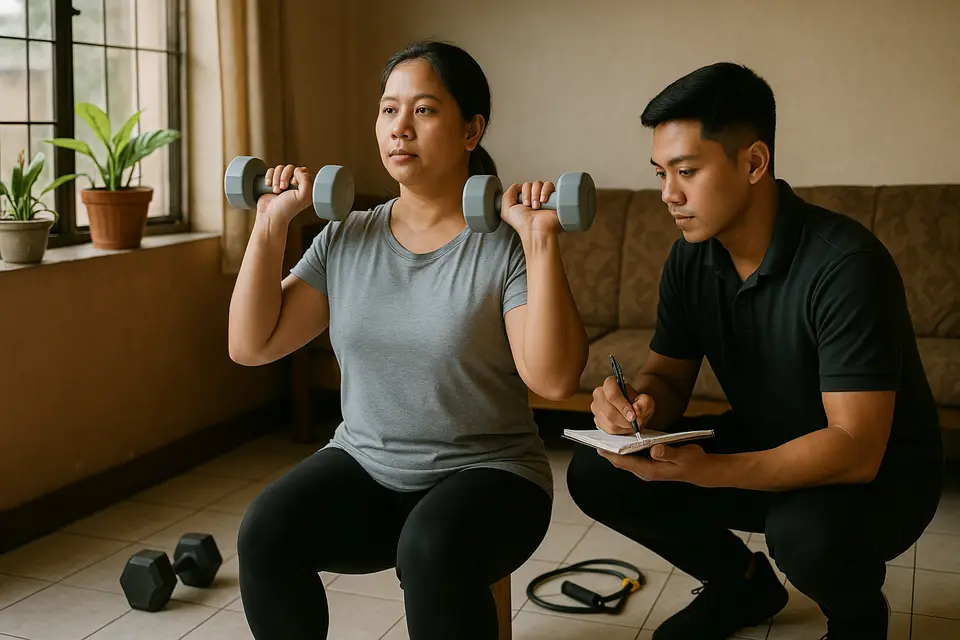
Generated illustration.
Progressive overload means making your training a little harder over time, on purpose, so your body keeps having a reason to adapt. Lift the same dumbbells for the same number of reps every week and your body adjusts in a few weeks, then stops changing. Ask for a little more, and it keeps responding.
It is the idea behind every strength programme that works, from a barbell gym to a sala with two dumbbells and a band. It is also the part most people skip when they train alone, because nobody is writing down what they did last week. On Fit Bud’s strength training coaching, the coach keeps that record for you and decides when it is time to add more.
What progressive overload means
Your muscles, tendons and bones respond to stress that is a bit more than they are used to. Once they have adapted, the same workout is no longer a challenge. The American College of Sports Medicine’s position stand on progression in resistance training (2009) names progressive overload as one of the core principles: to keep improving, the demand has to rise gradually.
“Gradually” is the important word. Progress that jumps too fast gets you hurt or wrecks your form. Progress that never happens leaves you doing the same workout for a year with the same result.
Ways to add more
Adding weight is the obvious one, but it is only one of several. Pick one at a time.
| Lever | What you change | Example at home |
|---|---|---|
| Load | Heavier weight or a stronger band | 4 kg dumbbells become 5 kg |
| Reps | More repetitions with the same weight | 8 goblet squats become 10 |
| Sets | More rounds of the same exercise | 2 sets of push-ups become 3 |
| Range | Moving further | Squat to a lower chair, or a deficit push-up off two books |
| Tempo | Slower lowering | Take three seconds to lower each squat |
| Harder version | A more difficult form of the move | Counter push-up, then chair, then floor |
| Frequency | One more session a week | Two strength days become three |
Weight is listed in the example for clarity only. What counts is the step from where you are, whatever your starting point.
The two-for-two rule
The ACSM position stand gives a simple trigger for adding load: when you can do one or two reps more than your target, on two sessions in a row, increase the weight by about 2 to 10 percent. Coaches often call this the two-for-two rule.
In practice, with a target of 8 to 12 reps:
- Pick a weight you can lift for 8 good reps.
- Each session, try to get one more rep on each set, with the same clean form.
- When you reach 12 reps on every set, two sessions running, move up to the next weight.
- With the heavier weight you will be back near 8 reps. Build up again.
The same ACSM document recommends a range of about 8 to 12 repetitions for people new to strength training, which is why this example uses it.
When you only have a few dumbbells
Most homes do not have a full rack. Small jumps in weight are the problem: going from 5 kg to 7.5 kg dumbbells is a big step for a shoulder press. Before you buy anything, use the other levers:
- Add reps until you reach the top of your range, then add a set.
- Slow the lowering to three or four seconds.
- Pause at the bottom of a squat or a press for two seconds.
- Move to a single-arm or single-leg version: a split squat with the same dumbbells is far harder than a squat.
Resistance bands come in steps of tension and are a cheap way to add load in small amounts. The resistance band exercises gallery shows the moves a coach uses most. If you have no weights at all, our guide to strength training at home with no equipment lists the bodyweight progressions.
Keep a log
Progressive overload only works if you know what you did last time. Write down the date, the exercise, the weight or band, and the reps for each set. A notebook works. So does a note on your phone.
When you open the log before a session, you have a target: one more rep than last week, or the same reps with a slower tempo. Without it, most people repeat whatever felt comfortable.
Signs you are adding too much, too fast
- Your form changes as you lift: knees cave in, the back rounds, or you swing the weight.
- Joint pain that lasts into the next day, as distinct from ordinary muscle soreness.
- Your reps go down for two or three sessions in a row.
- You dread the session or sleep badly.
If any of these show up, go back a step for a week. Progress is measured over months, and a week of easier work costs you nothing. If pain is sharp or does not settle, see a doctor or a physiotherapist before you continue.
How often to train
The World Health Organization’s 2020 guidelines on physical activity recommend muscle-strengthening activities that work all the major muscle groups on two or more days a week. Two or three full-body sessions a week, with a rest day between them, give your body time to adapt between each step up. Our free workout plan for the week lays those three sessions out.
Questions people ask
What is progressive overload in simple terms? Doing a little more over time than your body is used to, so it keeps getting stronger. More weight, more reps, more sets or a harder version of the exercise.
How fast should I increase weight? When you can do one or two reps above your target on two sessions in a row, add about 2 to 10 percent, as the ACSM position stand recommends. For a beginner that may be every week or two at first, then slower.
Can you do progressive overload without weights? Yes. Add reps, slow the tempo, pause at the hardest point, or move to a harder version of the move, such as a floor push-up after a chair push-up.
Does progressive overload work for women and older adults? Yes. The principle is the same; the starting point and the size of each step are smaller. Older adults or anyone with a health condition should check with their doctor before starting a new programme.
Sources
American College of Sports Medicine, “Progression models in resistance training for healthy adults”, position stand, Medicine and Science in Sports and Exercise 41(3), 2009: progressive overload as a principle, the 2 to 10 percent load increase after one or two reps over target on two consecutive sessions, and 8 to 12 repetitions for novices. World Health Organization, Guidelines on physical activity and sedentary behaviour, 2020: muscle-strengthening activity on two or more days a week.
Getting help with it
The hard part is rarely the theory. It is judging, set by set, whether the form is still good enough to add more, and keeping the record week after week. That is what a coach does on Fit Bud’s strength training coaching, at your home, your condo gym or online. Players training for a league can apply the same idea to running in our basketball conditioning drills, and the same week-by-week build is how people prepare for a Hyrox workout. For readers just starting, the beginner fitness programme begins with the basics before any weight goes up. If you would like a coach to plan your progression, tell us your town and your goal.