
Generated illustration.
Basketball conditioning drills train the thing a pickup game exposes first: being able to sprint, stop, defend and still shoot straight after the third quarter. The good news is that the best drills need nothing but a court, a ball and a watch, so a barangay court at six in the morning is as good a place as any gym.
This guide is for a player getting ready for a liga, a school team or simply weekend games. On Fit Bud’s sports conditioning coaching, a coach builds these drills into a plan around your season, and comes to your court or your home.
What basketball conditioning trains
A game is short bursts of hard running, cutting and jumping, broken up by walking, free throws and timeouts. So conditioning for basketball looks different from jogging laps. It trains you to:
- sprint hard for a few seconds, recover quickly, and sprint again
- change direction and stop without losing balance
- stay low in a defensive stance for a whole possession
- shoot and finish with good form while tired
Long, slow running has a place in the off-season, but the drills below are built around the stop-start pattern of the game.
Warm up first
Spend eight to ten minutes getting warm before any of these drills: easy jogging around the court, skips, side shuffles, carioca, leg swings and a few build-up sprints at half speed. Our guide to stretching before a workout explains why a moving warm-up suits the start of a session better than long static stretches. Finish every court session with a few minutes of walking and the stretches in our cool down exercises guide.
Seven conditioning drills
1. Lines (suicides)
Start on the baseline. Sprint to the free-throw line and back, to half court and back, to the far free-throw line and back, then to the far baseline and back. Touch each line with your hand. Rest about twice as long as the run took, then repeat. Start with four runs and build up over the weeks.
2. Sideline 17s
Sprint from one sideline to the other and back, seventeen times in a row, touching each line. It is one of the toughest drills in basketball, so begin with fewer crossings, such as nine, and add two crossings a week as your fitness improves.
3. Defensive slides
Get into a defensive stance: feet wider than the shoulders, knees bent, chest up, hands active. Slide across the lane and back without crossing your feet or standing up. Work for 20 to 30 seconds, rest, and repeat. Add a partner calling directions to make you react.
4. Full-court layups
Dribble the length of the court at speed, make a layup, rebound, and go back the other way for a layup with the other hand. Count the makes in one minute. This trains finishing while tired, which is where games are decided.
5. Cone shuffle and sprint
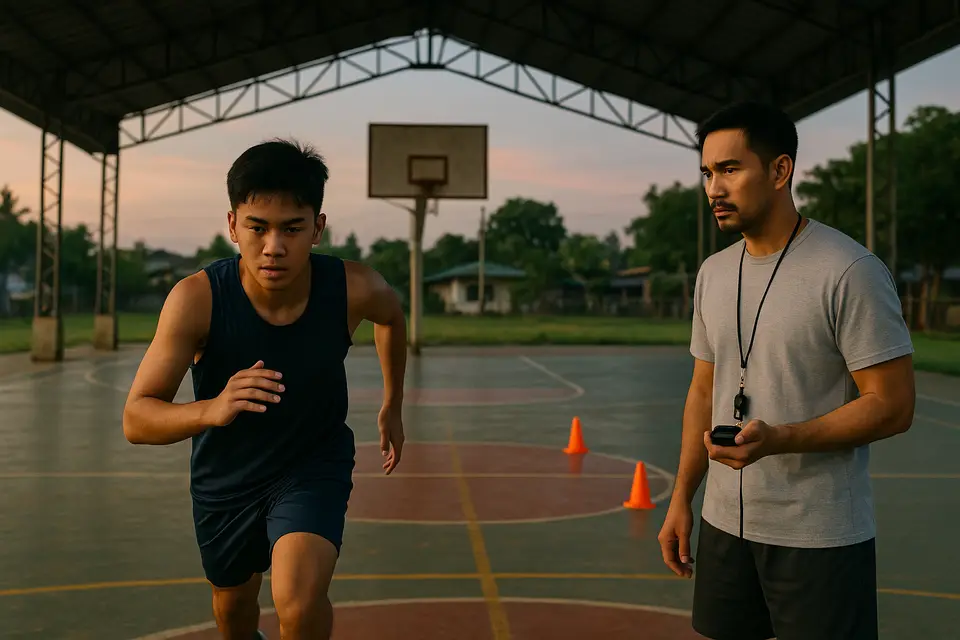
Set two cones about five steps apart. Shuffle to the first, sprint forward to the second, backpedal to the start. The changes of direction train the footwork for closing out and recovering on defence. The outdoor sessions gallery shows the cone shuffle on a court.
6. Jump rope
Two or three minutes of skipping at a steady rhythm, then 20 seconds fast, then steady again. It trains the calves and ankles for jumping and landing, and fits on a carport when the court is taken.
7. Shooting after sprints
Sprint one line drill, then shoot five free throws straight away. Record how many you make. Over the weeks, the number made while breathing hard is a useful check on your conditioning.
A simple week
These are starting points to adjust, never fixed numbers. Leave at least one easy day between hard conditioning days.
| Day | Session |
|---|---|
| Monday | Warm-up, lines, defensive slides, shooting after sprints |
| Tuesday | Strength at home: squats, lunges, push-ups, planks |
| Wednesday | Skills and an easy shootaround |
| Thursday | Warm-up, 17s, cone shuffle and sprint, full-court layups |
| Friday | Rest or an easy walk |
| Saturday | Game, or a scrimmage |
| Sunday | Rest |
Strength work matters as much as running. Stronger hips and legs help with jumping and landing, and core work such as the dead bug and the glute bridge needs no equipment. Add to the strength days gradually, as our guide to progressive overload explains. For older players or anyone returning after a long break, start with the strength days and a reduced number of runs. Players who want something to aim at between seasons can look at the Hyrox workout, a race that mixes 1 km runs with strength stations.
Training in the heat
Courts in the Philippines are often outdoors or under a metal roof that holds the afternoon heat. Train early in the morning or after sunset, drink water before and during the session, and stop if you feel dizzy, sick, confused or stop sweating. Our guide to training in the Philippine heat covers timing, water and the warning signs in full.
If you have a heart condition, high blood pressure, asthma, or have ever fainted during exercise, ask your doctor before starting hard conditioning work.
Questions people ask
What are the best conditioning drills for basketball? Drills that copy the game’s stop-start pattern: lines, sideline 17s, defensive slides and full-court layups. They train repeated sprinting and recovery, which is what a game asks for.
How can I improve my basketball stamina at home? Jump rope, mountain climbers, stair or step-up intervals and strength work for the legs and core all fit at home. Save sprinting and changes of direction for the court, where you have room to stop safely.
How often should I do conditioning drills? Two hard conditioning days a week, with easier days between them, suits most players during the season. Add more in the weeks before a liga starts, and fewer once games are frequent.
Can I do conditioning on my own? Yes. A watch, a ball and a court are enough. A coach helps with the parts that are hard to judge alone: how much rest, when to add runs, and whether your form holds up as you tire.
Getting a coach for it
A coach watches what you cannot see in yourself: knees caving on landings, a defensive stance that rises after ten seconds, a jump shot that drops as the legs go. On Fit Bud’s sports conditioning coaching, the coach writes the drills, the strength work and the rest days around your league schedule, at your court or home, or online. If you would like that, tell us your town, your sport and your season.