Generated illustration.
Walking into a gym for the first time is harder than any of the exercises in it. Everyone seems to know what they are doing, the machines have no instructions, and the free weights area sounds like a construction site. That feeling lasts about two weeks. After that, a gym is a room with heavy things in it and some rules of politeness, and this guide covers both.
It also answers the question underneath: whether you need a gym at all. Fit Bud’s coaches train people in their sala, their condo gym, a clubhouse, a park, or a commercial gym they already pay for, so we have no stake in the answer.
Do you need a gym
No. Our no-equipment strength guide and the free weekly workout plan will take a beginner a long way in a sala with a mat and a chair.
A gym gives you three things a living room does not. Heavier weights than you would buy, which matter once bodyweight moves get easy. Machines that hold you in a safe path while you learn a movement. And a place that is only for training, away from the household and the television, which some people find is the thing that makes them turn up. Our comparison of a personal trainer and a gym membership weighs these in more detail.
If any of those three is what has been missing, a gym is worth it. If the problem is that you do not know what to do, a gym on its own will not fix that, and this guide is the start of the answer.
Choosing one
Visit two or three before you sign anything. Most gyms in the Philippines offer a day pass or a free trial session, and that is the time to look at the things that decide whether you will keep going.
- Distance. The gym you will use is the one that is on the way home, or ten minutes from the door. A better gym forty minutes away through traffic is a gym you will visit in January and April.
- Hours. If you train before work, check the opening time on weekdays. Some gyms open late on Sundays or close for holidays.
- Crowding at your hour. Visit at the time you would actually train. A gym that is empty at 10 am may have a queue for every rack at 6 pm.
- Equipment. For a beginner, the list is short: a rack of dumbbells going from light to at least 20 kg, one or two adjustable benches, a cable machine, a leg press, a lat pulldown or seated row, and some cardio machines. Barbells and squat racks matter later.
- Air conditioning and ventilation. In a Philippine gym this decides how hard you can work in the afternoon. Ask whether it is on at your hour.
- Cleanliness. Look at the benches, the mats and the shower. Paper towels and spray bottles near the machines are a good sign.
- Staff. Ask whether someone will show you the machines on your first visit. Most gyms do, and it is worth more than any brochure.
There is no price here because gym prices vary by city and change often. Ask for the full monthly cost including any joining fee, and whether the contract renews on its own.
What to bring and wear
Clothes you can move and sweat in, closed shoes with a flat sole, a towel, a water bottle, and a lock if the gym has lockers. A small notebook or a note on your phone to write down what you did. Leave the new outfit and the lifting gloves for later. Nobody is looking.
The unwritten rules
- Wipe down a bench or machine after you use it.
- Put dumbbells and plates back where they came from, so the next person can find them.
- Do not sit on a machine between sets while scrolling. Rest beside it.
- If someone is using a machine you want, ask how many sets they have left, or ask to work in between their sets.
- Do not stand directly in front of the dumbbell rack to do your set. Take the weights a few steps back so others can reach the rack.
- Keep the phone to timing rests and writing down sets. Filming is fine in most gyms as long as other people are not in the frame.
Everyone in the room was a beginner once, and most people are glad to help if asked. Nobody is judging the weight on your bar.
Your first session
Spend the first visit learning the room. Ask a staff member to walk you round the machines you will use. Then do a short, easy session so that you leave feeling fine and come back.
A good first session is a five-minute walk on the treadmill or bike, then one or two light sets of each move below, learning the movement rather than working hard. Finish with the plank and a slow walk. Forty minutes, including finding things.
The beginner routine for the first month
This is a full-body session done three times a week with a day off between. It uses machines where they help a beginner and free weights where they teach more.
| Move | Where | Sets and reps | What it trains |
|---|---|---|---|
| Leg press, or goblet squat with a dumbbell | Machine, or the dumbbell area | 2 to 3 sets of 10 to 12 | Thighs, glutes |
| Chest press machine, or dumbbell floor press | Machine, or a mat | 2 to 3 sets of 10 to 12 | Chest, front of shoulders, triceps |
| Lat pulldown or seated cable row | Cable station | 2 to 3 sets of 10 to 12 | Upper back, biceps |
| Dumbbell Romanian deadlift | Dumbbell area | 2 to 3 sets of 10 to 12 | Back of the legs, glutes, lower back |
| Seated dumbbell shoulder press | A bench with a back | 2 sets of 10 to 12 | Shoulders, triceps |
| Farmers carry | Any clear floor | 3 carries of 20 to 30 metres | Grip, posture, trunk |
| Plank | A mat | 3 holds of 10 to 20 seconds | Trunk |
Rest about a minute between sets. The whole thing takes 40 to 50 minutes with a warm-up.
How to pick the weight
Choose a weight you can lift for 12 repetitions with the last two feeling hard but still clean. If you reach 12 easily, go up one step next time. If your form changes before 8, go down. On machines, the pin moves one plate at a time, which makes this easy. With dumbbells, the next pair up is usually 1 or 2 kg heavier.
Write down the weight and the reps for every set. This is the only way to know, three weeks from now, that you are stronger.
Why these moves
Together they cover a squat, a hinge, a push, a pull, a press, a carry and the trunk, which is the same pattern as the free weekly plan, done with heavier loads. The machine versions hold you in a fixed path, which is why the chest press and leg press are good first choices while you learn to brace. The Romanian deadlift and the carry are done with dumbbells because no machine teaches the hip hinge and the upright posture as well. Our guides to the farmers carry and the chest workout go into those moves in detail.
The four weeks
| Week | What changes |
|---|---|
| 1 | Learn the moves. 2 sets each, light. Leave feeling fresh |
| 2 | 2 to 3 sets. Add weight on anything that reached 12 clean reps |
| 3 | 3 sets on every move. Add a 10-minute walk or bike at the end |
| 4 | Keep 3 sets, keep adding weight where the reps allow, and note what felt best |
At the end of the month you will know the room, know your weights, and have a notebook that shows progress. That is the point at which a programme written for you, rather than for beginners in general, starts to pay. Our guide to progressive overload explains how to keep that progress going.
The cardio machines
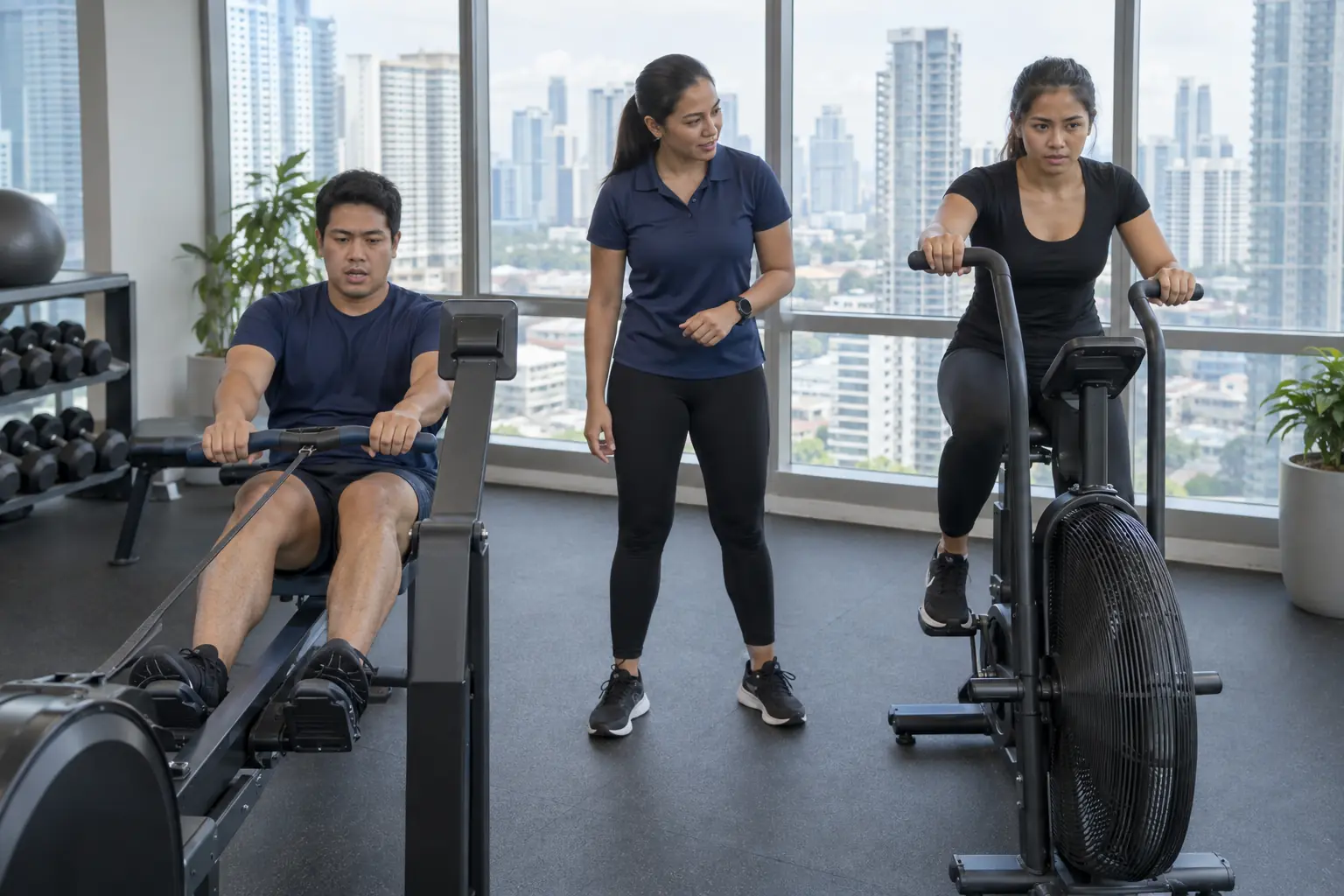
A treadmill, an upright or recumbent bike, a rower, a stair climber and an elliptical do the same job: raise your heart rate without impact from the road. Any of them works for the warm-up and for the walk days in the plan. Start on the bike if your knees complain, and on the treadmill at a walk if you want the most natural movement. The rower is excellent but easy to do badly, so ask for the leg, body, arm order to be shown to you.
Common beginner mistakes
- Copying the person next to you. They are on a different programme for a different body with a different history.
- Doing an hour of cardio and nothing else because the machines are less frightening. Strength work is what changes how you move and how you look.
- Training arms and abs every visit and skipping legs and back.
- Going five or six days in the first week, then being too sore to return.
- Training through sharp joint pain. Muscle burn is fine. Joint pain is a signal to stop that move and ask.
- Not eating or drinking before an evening session after a long day. A small meal an hour or two before helps.
Who should check first
If you have a heart condition, high blood pressure that is not controlled, diabetes, a recent operation, or you are pregnant, talk to your doctor before you start. Tell the gym staff about anything that affects what you can do. If an exercise causes sharp pain, or pain that lasts into the next day in a joint rather than a muscle, stop it and see a doctor or a physiotherapist.
Questions people ask
How often should a beginner go to the gym? Three times a week with a rest day between sessions. That is enough to get stronger and to build the habit without the soreness that stops people in week two.
How long should a beginner stay at the gym? Forty-five minutes to an hour, including the warm-up. Longer sessions add tiredness faster than results.
What should I do on my first day at the gym? Walk round with a staff member, learn where the machines are, then do one or two easy sets of each move in the routine above. Leave feeling fresh.
Should a beginner use machines or free weights? Both. Machines hold you in a safe path while you learn to brace, and free weights teach balance and the movements you use in daily life. The routine above mixes them for that reason.
Is it okay to go to the gym alone? Yes. Most people train alone, and staff are there to help. If you want someone watching your form in the first month, that is what a coach is for.
Having a coach come to your gym
Fit Bud’s coaches meet clients at the gym they already pay for, as well as at home or in a condo gym. The first session is a consultation and a movement screen, and it ends with a written plan you keep. The coach runs the sessions with you until the room feels like yours. Our strength training and beginner fitness program pages explain how that works, and a transport charge quoted by distance applies to in-person sessions. To start, tell us your town, your gym and your goal.
Sources
World Health Organization, Guidelines on physical activity and sedentary behaviour, 2020: muscle-strengthening activity on two or more days a week. American College of Sports Medicine, Progression Models in Resistance Training for Healthy Adults, position stand, 2009: novices should train each muscle group 2 to 3 days a week, with 8 to 12 repetitions per set.