
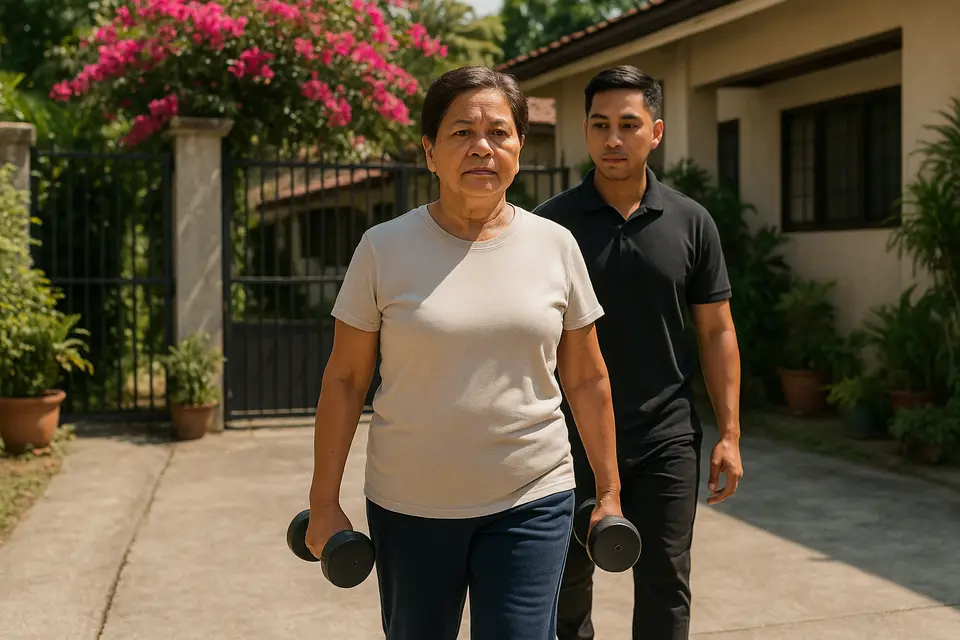
Generated illustration.
The farmers carry is about as simple as strength training gets: pick up a heavy weight in each hand, stand tall, and walk. It trains your grip, shoulders, trunk and legs together, and it copies the carrying you already do with groceries, water containers and sacks of rice.
It is also one of the eight stations in a Hyrox race, which is why it has become more popular lately. On Fit Bud’s strength training coaching, carries are one of the first loaded moves a coach adds, because they are hard to do wrong and easy to make harder.
How to do a farmers carry
- Set a weight on each side of your feet: dumbbells, kettlebells or two full water jugs.
- Push the hips back, keep the back flat, grip the handles and stand up, as you would in a deadlift.
- Stand tall: chest up, shoulders level and pulled slightly back, eyes forward.
- Walk with short, steady steps. Do not let the weights swing or knock your legs.
- At the end, stop, then set the weights down the same way you picked them up, hips back and back flat.
The exercise form gallery shows a carry with two water jugs and a coach keeping the shoulders level.
What it trains
- Grip. Your hands and forearms hold the whole load the entire time.
- Posture. The upper back and shoulders have to work to stop the weight dragging you forward.
- Trunk. Your stomach and back muscles keep the body upright with every step.
- Legs. Walking under load works the hips, thighs and calves.
How heavy, and how far
Pick a weight you can carry for 20 to 30 metres with your shoulders level and your steps even. If your shoulders round forward, you lean to one side, or the grip slips before the end, it is too heavy.
| Level | Starting point | Session |
|---|---|---|
| Beginner | Light dumbbells or half-full jugs | 3 or 4 carries of 20 m, rest a minute between |
| Some training | A weight that is hard by the end of 30 m | 4 carries of 30 m |
| Training for Hyrox | Work towards the race weight | Carries of 50 to 100 m, building to 200 m |
For reference, the Hyrox race uses two 16 kg kettlebells for women and two 24 kg kettlebells for men in the Open division, carried 200 metres. That is a target for racers. A beginner does not need anywhere near it.
To progress, change one thing at a time: a little more distance, a little more weight, or less rest. Our guide to progressive overload explains how to judge when it is time.
Four variations
Suitcase carry. One weight in one hand only. The body has to work hard to stay upright and not lean, so it trains the sides of the trunk. Carry, then switch hands.
Front-rack carry. Hold one or two kettlebells at chest height. It is harder on the upper back and breathing, and lighter on the grip.
Overhead carry. One weight held straight up. Only try this once your shoulders move freely overhead without pain.
Water jug carry. Two full containers from the house. A full 5-gallon water jug is heavy for most beginners, so start with smaller containers or partly filled ones.
Common mistakes
- Shrugging the shoulders up towards the ears. Keep them down and back.
- Leaning back or to one side to balance the weight.
- Walking fast and letting the weights swing.
- Picking up and setting down with a rounded back.
Who should check first
Ask your doctor before loaded carries if you have high blood pressure, a heart condition, a hernia, or pain in the lower back, shoulders or wrists. Older adults can do carries well, starting very light; our guide to strength and balance training for seniors has the gentler moves to begin with.
Where it fits in a week
Put carries at the end of a strength session, after squats and rows, two or three times a week. They pair well with a kettlebell workout at home or the dumbbell workout, since you already have the weights out. If you are training for a race, the Hyrox workout guide shows how carries fit with the running.
Questions people ask
What muscles does the farmers carry work? The forearms and grip, the upper back and shoulders, the stomach and lower back, and the legs. It works most of the body at once.
How heavy should a farmers carry be? Heavy enough that the last few metres are hard, light enough that your posture does not change. For most beginners that is a light pair of dumbbells or two partly filled water jugs.
How long should you do the farmers carry? Start with 20 to 30 metres per carry, three or four times, with a minute of rest between. Build distance before you add much weight.
Is the farmers carry good for older adults? Yes, done light and with a steady walk. It copies carrying groceries and helps grip and balance. Check with a doctor first if you have a heart condition or joint pain.
Getting help with it
Carries are simple, but a coach can see what you cannot feel: a shoulder that drops, a lean to one side, a rounded back on the pick-up. Fit Bud’s strength training sessions happen at your home, condo gym or clubhouse, and the coach brings weights as agreed. For older family members, fitness for seniors uses carries at a much gentler level. If you would like someone to check your carry, tell us your town and your goal.
Sources
HYROX, “The Fitness Race” (hyrox.com): the farmers carry station, 200 m, with two 16 kg (Women Open) or two 24 kg (Men Open) kettlebells.