
Generated illustration.
Somewhere in the first weeks after the birth, most mothers catch their reflection and wonder why the tummy still looks months pregnant. Relatives notice too, and the comments at family gatherings do not always help.
A rounded belly after birth is normal. It took nine months to grow and it does not disappear in a week. One part of it, which the NHS explains, is the stomach muscles themselves: they were stretched and pushed apart to make room for the baby. What helps is mostly patience, plus a few quiet exercises that most people skip because they do not look like exercise.
Nothing here is medical advice. It follows what the NHS and the American College of Obstetricians and Gynecologists (ACOG) tell new mothers, and your own OB-GYN has the final word.
Why the tummy stays rounded
During pregnancy, the growing womb pushes the two long muscles down the front of the stomach apart, making them longer and weaker. The NHS says the gap is usually about two finger widths and will usually go back to normal by the time the baby is eight weeks old. While the gap is still there, the middle of the tummy can dome or bulge when you sit up or strain.
For some women the gap stays open. That is called diastasis recti, and our guide to diastasis recti exercises after birth shows how to check it at home with your fingertips and what to do about it.
When to start moving
The NHS says that after a straightforward birth, gentle exercise can start as soon as you feel up to it: walking, gentle stretches and pelvic floor exercises. It suggests waiting for advice at your six-week postnatal check before anything high-impact, such as aerobics or running. After a caesarean or a more complicated delivery, recovery takes longer, so talk to your doctor or midwife before anything strenuous.
ACOG gives a similar picture: for a healthy pregnancy and a normal vaginal birth, it is usually safe to begin a few days after giving birth, or as soon as you feel ready, working towards 20 to 30 minutes of activity a day. It adds that even ten minutes helps, and to stop if you feel pain.
What helps first
Deep stomach squeeze. The NHS gives this one for toning the stomach. Lie on your side with your knees slightly bent and let your tummy relax. Breathe in gently. As you breathe out, draw in the lower part of your stomach like a corset, narrowing your waist, and squeeze your pelvic floor. Hold for a count of ten while breathing normally, then let go, up to ten times.
Pelvic floor exercises. Squeeze as if holding in wind and stopping the flow of urine, hold for up to ten seconds, then relax; then quick squeezes until the muscles tire. The NHS suggests building up to ten of each, at least three times a day, breathing normally and without pulling in the stomach. If you are not sure you are squeezing the right muscles, our kegel exercise guide walks through finding them.
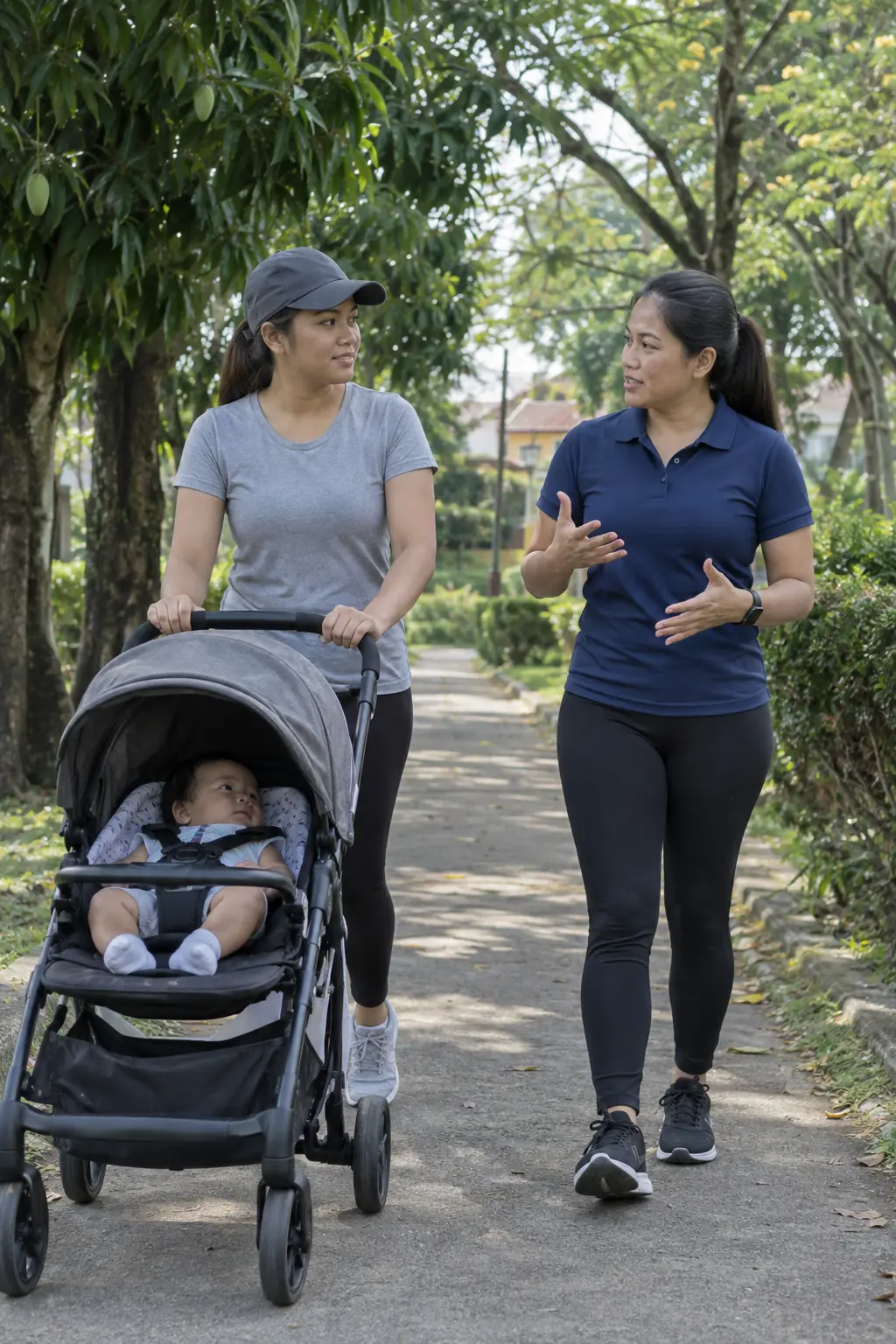
Walking with the stroller. The NHS suggests pushing the pram briskly with your arms bent and your back straight, the handles at a height where your elbows sit at right angles. In the Philippines that usually means early morning or the mall on a rainy day, with water in the stroller basket.
Posture through the day. Feeding, carrying and bathing a baby pull you forward for hours. The NHS advice is to sit supported while feeding, kneel or squat for tasks near the floor instead of bending your back, and bend your knees and keep your back straight when lifting.
What to leave for later
Sit-ups, crunches and planks are the first things many people try for a flat stomach, and they are the ones to wait on. The NHS advises avoiding sit-ups, planks and high-impact exercise to start with, and avoiding heavy lifting and straining on the toilet. Cleveland Clinic’s patient guide on diastasis recti adds crunches of any kind, downward dog and double leg lifts.
Many mothers wear an abdominal binder in the weeks after the birth. If you want to use one, ask your OB-GYN first, especially after a caesarean.
Take these to your doctor
Tell your doctor or midwife if the gap between the stomach muscles is still obvious eight weeks after the birth, which the NHS links to a risk of back problems, or if the tummy is painful. The six-week check is the natural time to ask, and there is no need to wait for it if something feels wrong.
The NHS also asks new mothers to look after their mental health as well as their body. If you feel low, anxious or unable to cope, talk to your doctor or midwife; depression after a birth is common and help is available.
Food and weight
There is no set timetable for the rest. The NHS suggests that a new mother who thinks she needs to lose weight asks her doctor or health visitor about support, and tells any weight-loss group that she has recently had a baby and whether she is breastfeeding. For everyday Filipino dishes that are lighter without being a diet, see our healthy ulam ideas for the week.
Where a coach fits
Fit Bud’s pre- and post-natal fitness sessions start only once your doctor has cleared you in writing. The coach does not diagnose or treat a muscle gap or any other condition, and works inside what your doctor or physio has said. What a coach adds is a plan that fits around feeds and naps, at home, and a steady return to the strength a mother uses all day.
To see the gentle moves in real homes, look through the pregnancy and after-birth gallery. When you are cleared and ready, tell us your town and how many weeks since the birth.