Generated illustration.
A cool down is the last part of a workout, where you keep moving but slow everything down on purpose: easy walking, then a few gentle stretches, then normal breathing before you sit, shower or head for the jeepney. It takes about five minutes, and for most people it is the part of the session that gets skipped.
This guide explains what a cool down actually does, lists ten cool down exercises you can do anywhere, and gives a routine that fits after a strength session, a run, a game on the court or a session with a coach on Fit Bud’s beginner fitness programme.
What a cool down is for
Three things, in plain words.
It lets the heart and breathing settle gradually. After hard effort the heart is pumping fast and the blood vessels in the legs are wide open. Stopping dead and standing still, or sitting straight down, is when some people feel light-headed. A few minutes of easy walking keeps the leg muscles squeezing blood back up towards the heart while everything slows.
It is the right time to stretch. The muscles are warm, so the held stretches that are a poor idea at the start of a session are a good idea at the end. Our guide to stretching before a workout explains why the long holds belong here and not in the warm-up.
It closes the session. A calm two minutes at the end makes the next session more likely, and that is what training is mostly about.
One thing a cool down does not do: the research on it is honest about this. A 2018 review in Sports Medicine found little evidence that an active cool down reduces next-day soreness or improves the next day’s performance. If you are sore the day after a session, the cool down was not the cause, and a longer one would not have prevented it. The reasons to do it are the three above.
Ten cool down exercises
Use three or four of these, not all ten. Do the walking first, the stretches after.
- Slow walking. Two or three minutes, slowing each minute, arms loose. After a run or a court session, make this the longest part.
- Marching in place, winding down. For a sala with no room to walk: march with the knees lower each twenty seconds until you are just shifting weight from foot to foot.
- Shoulder rolls and arm circles. Ten slow rolls back, ten small circles each way. Good after pushing, pulling and carrying.
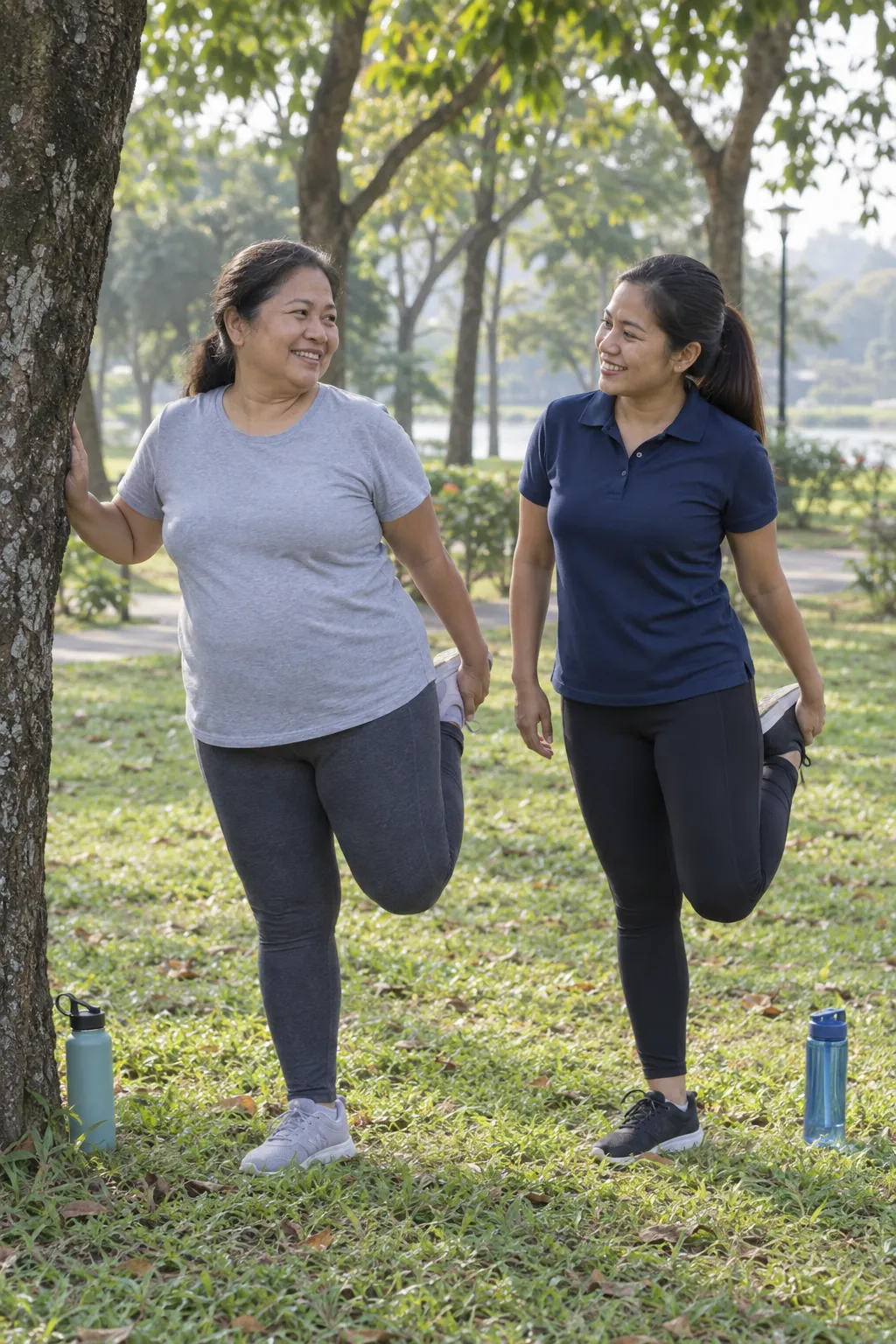
- Standing quad stretch. Hold a wall or a tree, bring one heel towards the buttock, knees together, and hold for 20 to 30 seconds each side. The outdoor sessions gallery shows it under the trees in a park.
- Standing hamstring stretch. One heel on a low step or kerb, leg straight, lean forward from the hips with a long back until the back of the thigh pulls gently. 20 to 30 seconds each side.
- Calf stretch at a wall. Hands on the wall, one foot back, heel down, lean in. 20 to 30 seconds each side. Important after running, jumping and stairs.
- Kneeling hip flexor stretch. One knee on the mat, the other foot forward, push the hips gently forward until the front of the back hip stretches. 20 to 30 seconds each side. Good after sitting all day as well as after lunges.
- Doorway chest stretch. Forearm on a door frame, elbow at shoulder height, turn the body gently away. 20 seconds each side. For anyone who trains chest or sits at a keyboard.
- Cat-cow on hands and knees. Round the back up, then let it sag, slowly, for eight to ten breaths. A gentle way to move the spine after carrying or squatting.
- Lying down and breathing. On your back, knees bent, one hand on the stomach. Ten slow breaths, in through the nose, longer out than in. This is the end.
Hold every stretch still. No bouncing, and no pushing into pain. A stretch should feel like a pull, not a strain.
A five-minute routine
| Minutes | What to do |
|---|---|
| 0 to 2 | Walk, or march in place, slowing each minute |
| 2 to 3 | Shoulder rolls, arm circles, then eight slow cat-cows |
| 3 to 5 | Four held stretches for whatever you trained, 30 seconds each |
After a leg day: quads, hamstrings, calves, hip flexors. After an upper-body day: doorway chest, shoulders, and a quad stretch anyway because it feels good. After a run or basketball: the walking part goes to three or four minutes, then calves and hamstrings. After a family session, our guide to small group training with family describes the group finish before the cool down.
If you have only two minutes, walk for one and stretch the one muscle that feels tightest for the other.
Cooling down in the Philippine heat
Heat makes the first reason for a cool down more important. After hard work in a hot gym, a covered court or a yard at ten in the morning, the body is pushing a lot of blood to the skin to lose heat, and stopping suddenly is when people feel faint. Keep walking, move into shade or in front of a fan, and drink water during the walk rather than after it. Our guide to training in the Philippine heat covers timing and the signs that mean stop.
A cold shower straight after a hot session feels wonderful and is fine once the breathing has settled. The cool down is the two or three minutes before it.
Common mistakes
- Stopping dead and sitting on the floor the moment the last set ends.
- Stretching cold, before the walking part. Walk first, stretch second.
- Bouncing in a stretch, or pulling until it hurts.
- Treating the cool down as a second workout. It is slow by design.
- Skipping it to beat the traffic. The walk to the gate, the tricycle or the jeepney counts, if you make it a slow one.
Who should check first
If you have fainted during or after exercise, have a heart condition, or take medicine for blood pressure, ask your doctor how to finish sessions and mention that you feel dizzy when you stop. Older adults and anyone pregnant should keep the walking part longer and skip any stretch that needs lying flat if it feels uncomfortable.
Questions people ask
What are 5 cool down exercises? Slow walking, a standing quad stretch, a hamstring stretch with the heel on a step, a calf stretch at a wall, and cat-cow on hands and knees. Together they take about five minutes.
What is a cool down exercise? Any light, easy movement done at the end of a workout to bring the heart rate and breathing down gradually, usually followed by a few held stretches while the muscles are warm.
Why is cooling down important? It lets the heart and blood flow settle instead of stopping suddenly, which is when people feel light-headed, and it is the safest time in the session to stretch. It does not prevent next-day soreness.
How long should a cool down be? Five to ten minutes is the usual recommendation. Two minutes of walking and three of stretching is enough after most home sessions.
Is stretching a cool down? Stretching is part of one. The walking or slow marching that comes first is the part that settles the heart; the stretches come after.
Do I need to cool down after walking? After a brisk walk, slowing the last few minutes to an easy pace is a cool down in itself. Add a calf stretch if the calves feel tight.
Getting the whole session planned
A coach plans the cool down around what you just did and around whatever feels stiff that week, so it stops being an afterthought. On Fit Bud’s beginner fitness programme the session always ends this way, at your home, condo gym or clubhouse. For players, sports conditioning builds the finish into court sessions too. If you would like a session with a proper start and finish, tell us your town and your goal.
Sources
American College of Sports Medicine, ACSM’s Guidelines for Exercise Testing and Prescription, 11th edition, 2021: a cool down of at least 5 to 10 minutes of light-to-moderate activity, and flexibility exercise when the muscles are warm. Bas Van Hooren and Jonathan M. Peijs, “Do We Need a Cool-Down After Exercise? A Narrative Review of the Psychophysiological Effects and the Effects on Performance, Injuries and the Long-Term Adaptive Response”, Sports Medicine, 2018: little evidence that an active cool down reduces next-day soreness or improves next-day performance.