
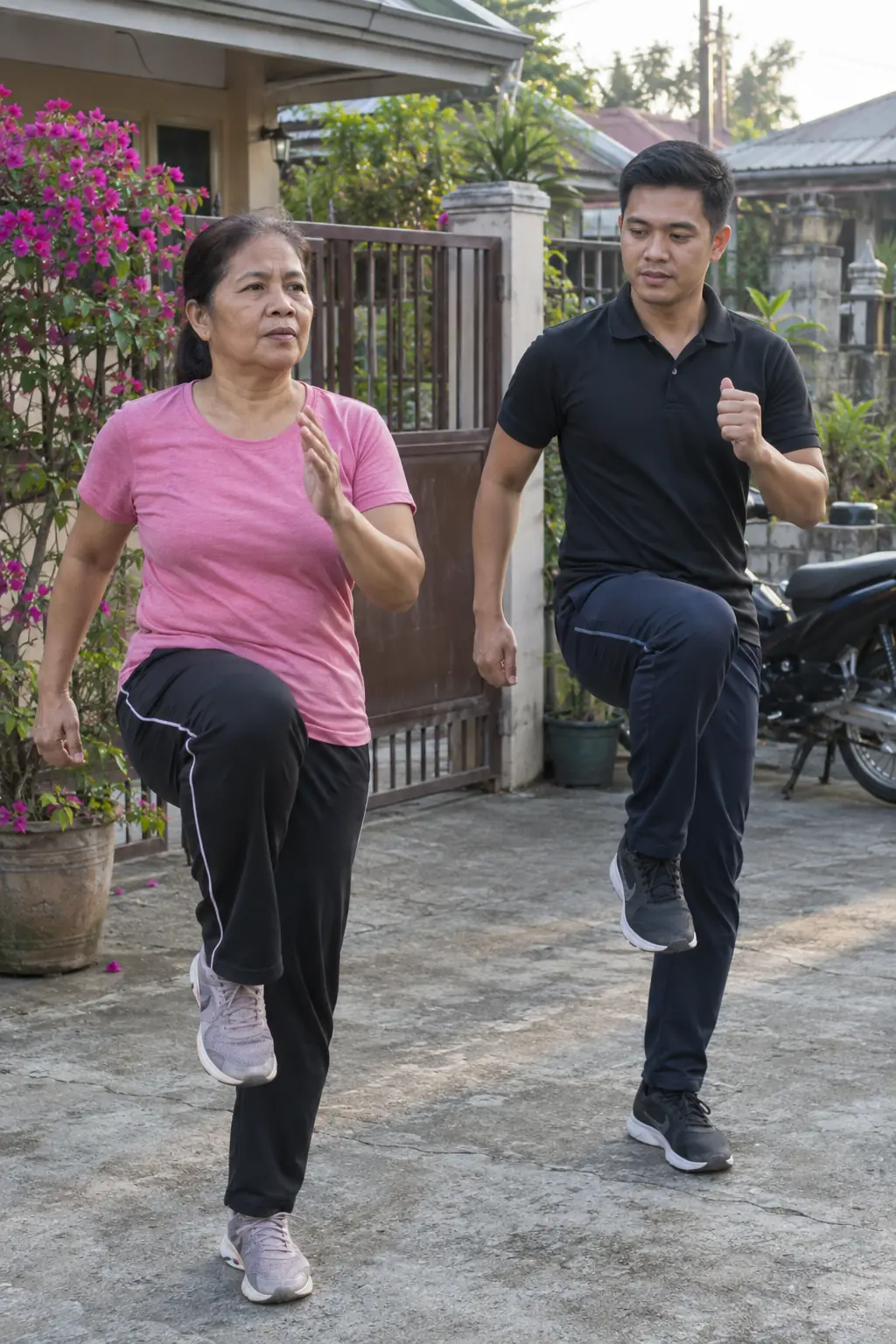
Generated illustration.
Most of us learned to stretch at school: stand in a line, reach for your toes, hold for a slow count of twenty, then run. It feels like the responsible thing to do before exercise. For the start of a session, though, many coaches now prefer something different, and the reason is simple once you see what each kind of stretching does.
Two kinds of stretching
A static stretch is the school kind. You move into a position that lengthens a muscle and hold it still, usually for 20 to 60 seconds. It is good for flexibility over time and for winding down.
A dynamic stretch moves. Leg swings, walking lunges, arm circles, marching with high knees. The muscle lengthens and shortens through its range again and again, the heart rate rises, and the joints move the way the workout is about to ask them to.
Why a moving warm-up usually comes first
A warm-up has one job: to get the body ready for the session. That means warmer muscles, a higher heart rate, and joints that have already been through the movements you are about to load.
Moving does that. Holding still mostly does not, and several studies have found that long static holds done just before an effort can briefly reduce strength and power, though the effect is small and short holds make little difference. For a home session that is not a reason to fear stretching. It is a reason to put the long holds at the end and spend the first ten minutes moving.
If a particular stretch before training makes a stiff joint feel better, keep it and hold it briefly. There is no need to be strict about a habit that works for you.
A ten-minute warm-up for a home session
Do each for about a minute, easy at first and a little bigger each time.
March on the spot, lifting the knees higher as you go, arms swinging.
Arm circles, small then large, forwards then backwards.
Bodyweight squats to a chair, slow, tapping the seat and standing.
Reverse lunges, alternating legs, holding a counter or wall if balance is shaky.
Hip hinges with hands on the hips: push the hips back, flat back, stand tall.
Leg swings holding a wall, forwards and back, then side to side, each leg.
Then two or three light repetitions of the first exercise of the session itself. If the workout starts with a goblet squat, do a few with a lighter weight or none.
The home workouts gallery includes a marching warm-up in a front yard and a seated hamstring stretch for the end of a session; the outdoor sessions gallery shows a cool-down stretch under the trees.
Where static stretching belongs
After the session, when the muscles are warm, is a good time for the long holds. Five minutes is enough: hamstrings, hips, calves, chest and shoulders, each held for about 30 seconds without bouncing. It is also a calm way to finish and bring the heart rate down. Our guide to cool down exercises sets out a five-minute finish with ten stretches to choose from.
On rest days, a short stretching routine is a fine way to move without training, particularly for anyone who sits for most of the day.
The heat changes the warm-up
In the Philippines the air does part of the warm-up for you, especially at midday, which is one more reason to train early. A shorter warm-up is usually enough on a hot morning, and the priority shifts to water and shade. Our article on training in the Philippine heat covers timing and what to wear.
A coach sets this up once
The warm-up is the part of a session people skip first when training alone. A coach builds it around the day’s workout and around any stiff knee, hip or shoulder you bring, so it stops being a chore. Fit Bud’s personal training at home page explains how a session runs. If you would like one planned around your own body, tell us your town and your goal.