Generated illustration.
The triceps is the muscle on the back of the upper arm, and it has one job: straightening the elbow. It does that job at the end of every push-up, every press and every time you get up out of a low chair using your hands. It also makes up the larger part of the upper arm, so people who train only their biceps are working the smaller half.
This guide gives one triceps workout for home and one for the gym, explains what the three parts of the muscle do, and keeps coming back to a single form rule, because almost every triceps fault is the same one: the elbows moving when they should stay still.
The three heads, and why it matters
The triceps brachii has three parts, called heads, that join into one tendon at the elbow.
- The long head runs from the shoulder blade, so it crosses the shoulder joint as well as the elbow. It is worked hardest when the arm is overhead, which is why overhead extensions feel different from pressdowns.
- The lateral head sits on the outside of the arm and does most of the work in pressdowns and presses with the arms by the sides.
- The medial head lies underneath and works in every elbow extension, especially at the lockout.
A good triceps workout has one movement with the arms overhead and one with the arms down or in front, so all three heads are covered.
The one form rule
Lock the upper arm in place and move only the forearm. In a pressdown, the elbows stay pinned to the ribs. In an overhead extension, they point at the ceiling and stay beside the head. In a dip or a close push-up, they track straight back rather than out to the sides.
If the elbows drift, the shoulders and chest have joined in and the triceps have been let off. Lighten the load until the elbows stay put, and extend to a full straight arm at the top of every repetition, because the last few degrees are where the triceps do the most.
The home triceps workout
Needs a sturdy chair or bench, a band, and a dumbbell if you have one. Two or three sets of each, 10 to 15 repetitions, about a minute of rest between.
| Move | How | Watch for |
|---|---|---|
| Bench dip | Hands on the edge of a chair or bench behind you, feet on the floor, lower until the elbows reach about a right angle, press up | Shoulders stay down and the elbows point back. Do not sink below a right angle |
| Close push-up | Hands under the shoulders rather than wide, elbows brushing the ribs on the way down. From a table or the knees to begin | Same straight body line as any push-up |
| Overhead band extension | Stand on the band or anchor it low behind you, elbows up beside the head, extend to straight arms | Elbows stay beside the head and do not flare |
| Band pressdown | Band over the top of a door or a gate post, elbows pinned to the ribs, press the hands down to straight arms | Only the forearms move |
| Dumbbell overhead extension | Hold one dumbbell in both hands behind the head, elbows up, extend | Light weight; the long head gets a stretch at the bottom |
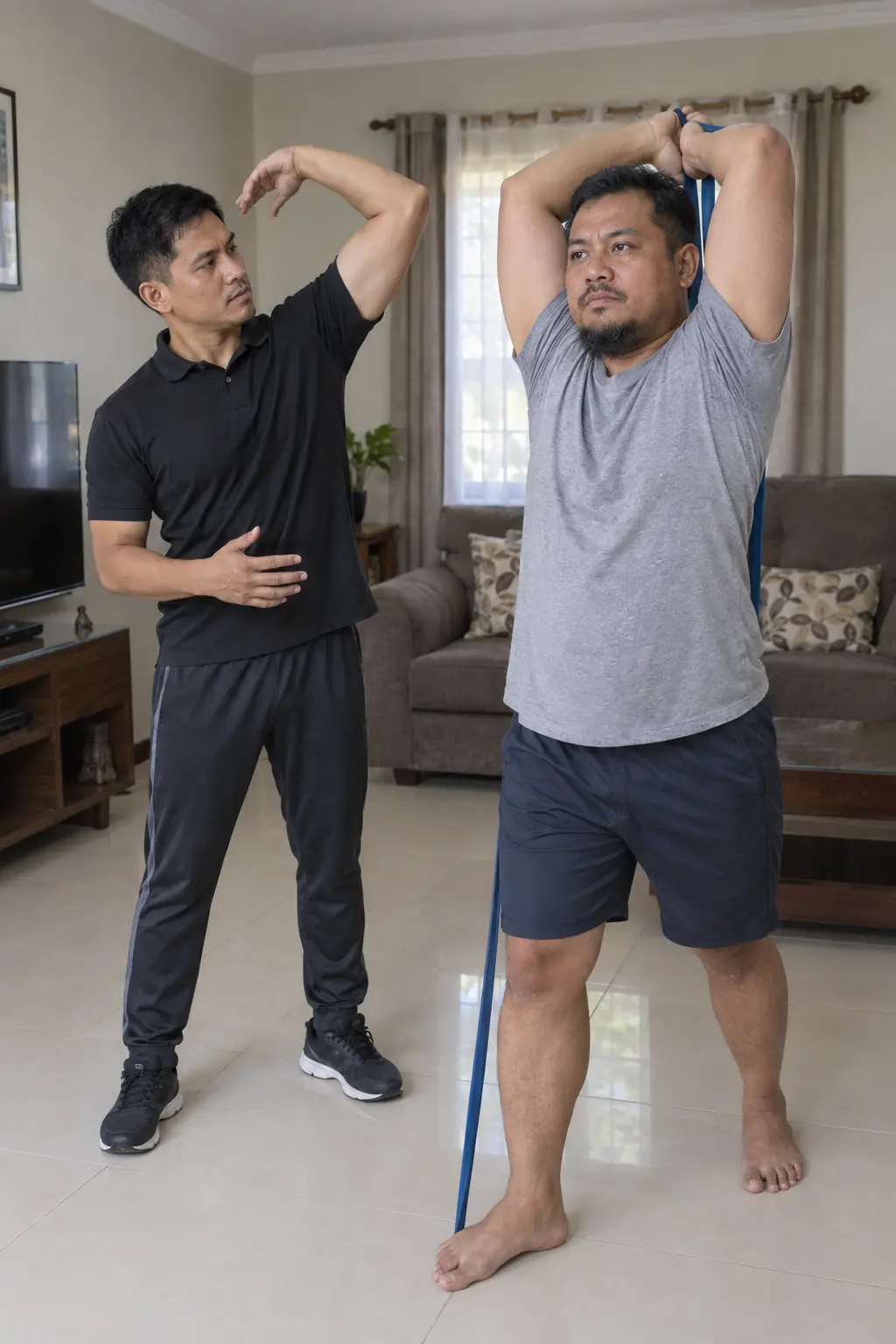
The resistance band gallery shows the overhead band extension with a coach demonstrating the elbow position, and the home workouts gallery shows the bench dip from a living room bench.
The gym triceps workout
Same sets and reps. Pick a weight where the last two repetitions are hard but the elbows do not move.
| Move | Why it is here | Notes |
|---|---|---|
| Cable pressdown, rope or straight bar | The easiest way to load the lateral and medial heads with the elbows pinned | Lean forward very slightly; do not shrug |
| Overhead cable extension | The long head, under a steady load | Face away from the stack, elbows up |
| Assisted dip or parallel bar dip | Heavy triceps work with the body upright | Stay upright for triceps; do not drop the shoulders below the elbows |
| Close-grip bench press | A press with the hands shoulder-width so the triceps take more of the load | Spotter or safety bars; elbows tucked |
| Lying dumbbell extension | The classic skull crusher, done with two dumbbells so each arm works alone | Keep it light; lower the weights to beside the ears, not the forehead |
Our guide to starting at the gym covers the room, the cable station and the manners.
How often
The triceps already work in every chest and shoulder press, so they need less direct work than people think. Two sessions a week of two or three triceps moves, on the same days as the chest workout or at the end of a full-body session, is plenty. A 2016 review by Schoenfeld and colleagues found that training a muscle twice a week built more than once a week, and more than that adds little for a beginner.
Progress by adding repetitions first, then a set, then a heavier band or weight. Our guide to progressive overload sets out the order.
Common mistakes
- Swinging the weight or leaning into the pressdown so the body does the work.
- Elbows drifting forward or out, especially on overhead extensions.
- Stopping short of a straight arm.
- Sinking too deep on bench dips with the shoulders rolled forward, which strains the front of the shoulder.
- Heavy skull crushers with a bar before the movement is learned.
- Training triceps every day. They are small, they recover in a day or two, and they are already working in your presses.
Elbows
The triceps tendon attaches at the point of the elbow, and the muscles of the forearm attach just beside it. A pain at the elbow during extensions, as opposed to a burn along the back of the arm, means the load is too heavy or the elbows are moving. Lighten it, slow it down, and swap a bar for a rope or a band for a few weeks. If the pain continues between sessions or wakes you at night, see a doctor or a physiotherapist rather than training through it.
A note on arm fat
A triceps workout builds the muscle at the back of the arm and makes it firmer and stronger. It does not remove fat from that spot, because no exercise removes fat from one chosen area. What changes how an arm looks is the muscle underneath, which this workout builds, and overall body fat, which comes down to food and activity across the whole week. Our guide to losing weight on a rice-based diet covers that side honestly.
Questions people ask
What is the best triceps workout? One overhead movement for the long head, one pressdown or dip for the lateral and medial heads, and a press with a close grip, done twice a week with the elbows locked in place. The two workouts above are built on that.
How many triceps exercises should I do? Two or three per session is enough, since every chest and shoulder press already works them.
Can I train triceps every day? You can, but it does little. Two sessions a week with a day or two between is what the research supports.
Do push-ups work the triceps? Yes, and the closer the hands, the more they do. A close push-up is one of the best bodyweight triceps exercises there is.
Can you train triceps at home without equipment? Yes. Bench dips from a chair and close push-ups through the usual progression cover the muscle well. A band adds the overhead work.
Having your extension checked
Drifting elbows are the one triceps fault nobody feels, and a coach spots them from the side in the first set. Fit Bud’s strength training sessions happen at your home, condo gym, clubhouse or a gym you already pay for, with bands or dumbbells brought as agreed. To have yours checked, tell us your town and your goal.
Sources
American College of Sports Medicine, Progression Models in Resistance Training for Healthy Adults, position stand, 2009: 8 to 12 repetitions and 2 to 3 sets for novices. Schoenfeld, Ogborn and Krieger, “Effects of Resistance Training Frequency on Measures of Muscle Hypertrophy: A Systematic Review and Meta-Analysis”, Sports Medicine, 2016: training a muscle group twice a week produced greater muscle growth than once a week.