
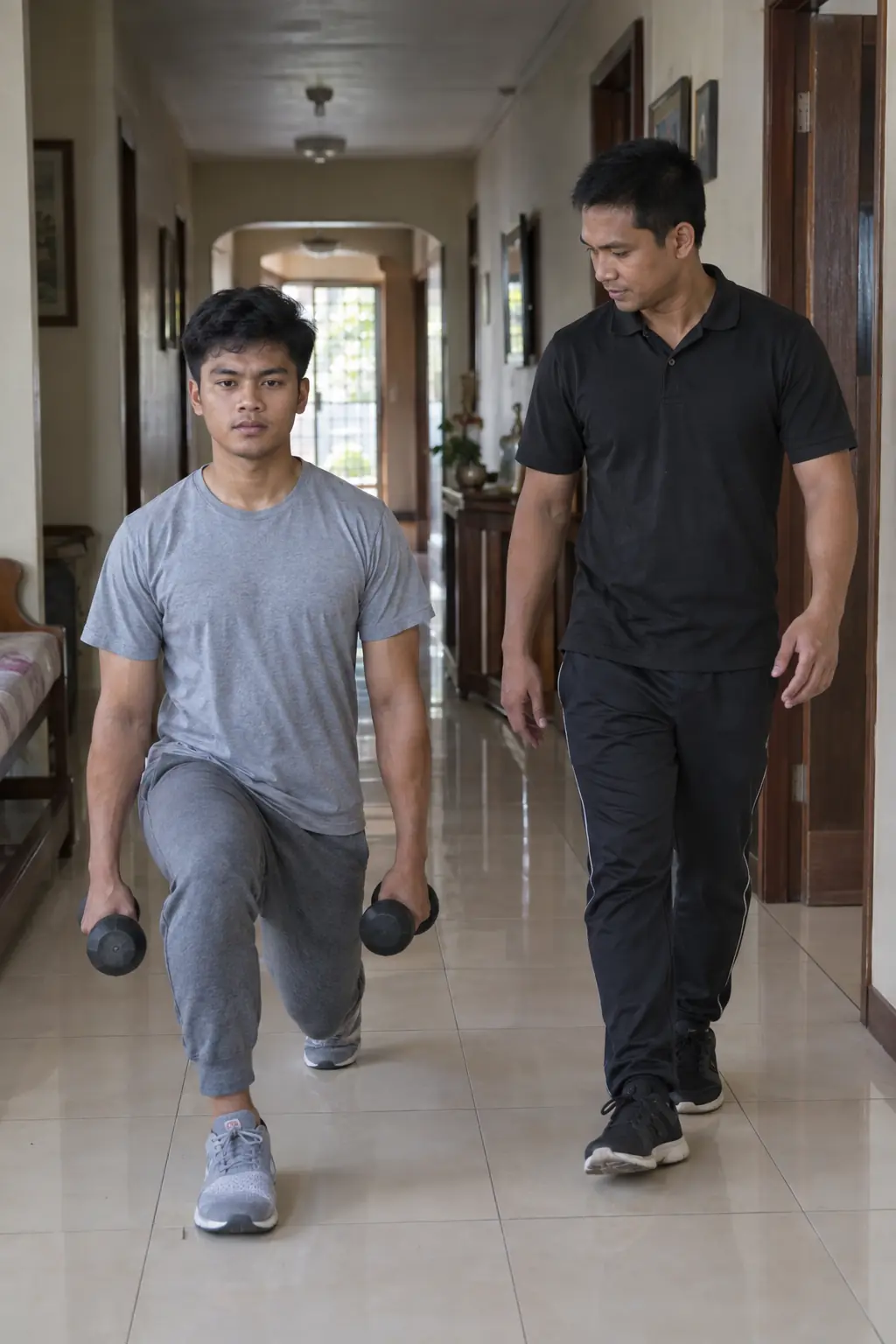
Generated illustration.
A lunge is a step into a split stance followed by a squat on the front leg. One leg does most of the work while the other steadies you, which is what makes it useful: almost everything you do on your feet, from climbing stairs to picking a child up off the floor, happens one leg at a time.
It is also an exercise that gets done badly more often than well, usually because people start with the hardest kind. This guide teaches the easiest kind first, explains what to watch, and then sets out the others in the order a coach would add them.
What muscles lunges work
The front leg does most of the work.
- Quadriceps, the front of the thigh, straighten the knee as you stand.
- Gluteus maximus, the main buttock muscle, drives the hip forward and up.
- Hamstrings, the back of the thigh, help the glutes and control the lowering.
- Adductors, the inner thigh, and the calves steady the leg.
- Gluteus medius, at the side of the hip, stops the pelvis dropping and the knee drifting in. This is why lunges improve balance in a way a two-legged squat does not.
- The trunk holds you upright through the whole movement.
The back leg gets a stretch through the front of the hip and some work in the quadriceps as it bends.
How to do a reverse lunge
Start here. Stepping backwards keeps the front shin close to vertical and the weight over the front heel, which most people find steadier and kinder on the knees than stepping forward.
- Stand tall with feet under the hips, hands on the hips or holding a wall or counter.
- Take a long step straight back with one foot, landing on the ball of that foot.
- Lower the back knee straight down towards the floor, keeping the torso upright. The front knee bends to about a right angle, with the front heel flat.
- Stop a few centimetres above the floor, or touch it lightly. Do not let the knee bang.
- Push through the front heel to stand, and bring the back foot forward to the start.
- Alternate legs, or do all the repetitions on one side and then the other.
The exercise form gallery shows a reverse lunge on a park path with a coach crouched to watch the front knee, which is exactly the view that matters.
The faults a coach corrects most
The front knee drifting inward. Look down: the knee should point the same way as the toes. If it collapses in, shorten the step, slow down, and think about pushing the knee gently out.
The front heel lifting. Weight has moved to the toes, usually because the step is too short. Lengthen it until the heel stays down.
Leaning forward. The chest drops towards the front thigh. Keep the eyes forward and the torso tall, as if a string from the ceiling were lifting the top of your head.
A short, shallow step. The knee goes past the toes and the back knee barely bends. Step further and lower further.
Pushing off the back foot. The front leg should do the standing. The back foot only steadies.
Rushing. Two seconds down, one second up. Lunges reward control more than most exercises.
The kinds of lunge, easiest to hardest
| Kind | How it differs | When to use it |
|---|---|---|
| Reverse lunge | Step back | The first one to learn, and the one to keep |
| Split squat | Feet stay in a split stance, no step; lower and rise in place | For learning depth and balance without the step |
| Forward lunge | Step forward and push back to the start | Once the reverse version is steady; harder on the knee because you have to stop forward momentum |
| Walking lunge | Step forward and keep going, alternating legs | Endurance and coordination; a hallway or a court is the track |
| Side lunge | Step out to the side, sit into that hip, keep the other leg straight | Inner thigh and side hip; useful for court sports |
| Split squat, back foot raised | Back foot on a low bench or step | More load on the front leg; a step towards single-leg strength |
| Curtsy lunge | Step back and across behind the other leg | Side hip emphasis; add once balance is reliable |
| Jumping lunge | Switch legs in the air | Power and conditioning; only after months of the others, and only with sound knees |
Walking lunges with a weighted backpack are also how most people train for the sandbag lunge station in a Hyrox race, which our Hyrox workout guide covers.
How many to do
Start with 2 sets of 8 on each leg, two or three times a week, with a day between. Build to 3 sets of 10 to 12 on each leg. That range sits inside what the American College of Sports Medicine recommends for people new to strength training, and it is enough to feel the next day.
Making lunges harder
In this order, one change at a time:
- Lower further, until the back knee lightly touches the floor.
- Slow the lowering to three seconds.
- Add a set.
- Hold a dumbbell at the chest, or one in each hand at the sides.
- Move to the next kind in the table.
Our guide to progressive overload explains how to judge when it is time.
Making lunges easier
Hold a wall, a counter or the back of a chair. Shorten the step and lower only halfway. Or start with the split squat, which removes the step entirely. The glute bridge is a good companion for anyone whose hips are not yet strong enough for single-leg work.
Lunges and knees
Lunges are a normal exercise for healthy knees, and a strong front thigh and hip tend to make the knee feel better over time, not worse. The reverse lunge keeps the shin more upright and is the kind most people with cranky knees find comfortable. Shorten the step, lower less far, and slow down before you give up on them.
Sharp pain in the knee during a lunge is different from the burn in the thigh. If it happens, stop that kind of lunge for the day. If it keeps happening, or there is swelling, see a doctor or a physiotherapist before you continue. No article can tell you what is going on inside your own knee.
Where lunges fit in a week
Lunges belong in a full-body strength session alongside a squat, a push, a pull and a hinge, as in our free weekly workout plan. Two or three sessions a week is enough. They are also a good moving warm-up before a run or a court session, done without weight, as our guide to stretching before a workout sets out. For older adults, the split squat and a short reverse lunge holding a chair are the versions our seniors strength and balance guide uses.
Questions people ask
What muscles do lunges work? Mainly the front of the thigh and the buttocks of the front leg, with the hamstrings, inner thigh and calf helping, and the side of the hip keeping the pelvis level. The trunk works to keep you upright.
Are lunges good for you? They build single-leg strength and balance, which carry straight into stairs, walking and sport. They also show up a weaker side, which a two-legged squat hides.
How many lunges should I do a day? You do not need them every day. Two or three sessions a week of 2 to 3 sets of 8 to 12 on each leg is plenty, with a rest day between.
Are lunges better than squats? They do different jobs. Squats let you load both legs together and go heavier. Lunges train each leg on its own and challenge balance. A good plan has both.
Are lunges bad for your knees? For healthy knees, no, and the reverse lunge is the gentlest kind. If a lunge causes sharp knee pain rather than thigh fatigue, stop and see a doctor or physiotherapist.
Getting your lunge checked
A knee that drifts in, a heel that lifts and a torso that leans are all things you cannot feel but a coach can see from the side. Fit Bud’s strength training and beginner fitness program sessions happen at your home, condo gym, clubhouse or court, and single-leg work is part of the movement screen at every first session. To have yours looked at, tell us your town and your goal.
Sources
American Council on Exercise, Exercise Library, “Forward Lunge” and “Reverse Lunge”: target muscles and form cues. American College of Sports Medicine, Progression Models in Resistance Training for Healthy Adults, position stand, 2009: 8 to 12 repetitions and 2 to 3 sets for novices, 2 to 3 days a week. HYROX, “The Fitness Race” (hyrox.com): the 100 m sandbag lunge station.