Generated illustration.
Watch someone lift a heavy pot off the stove, or carry a sleeping child from the car. Their arms do the lifting, but it is the middle of the body, holding still, that stops the back from taking the strain. A plank trains exactly that stillness.
It is also the exercise most people do wrong, usually because they are trying to hold it for as long as possible. A plank is judged by the line of the body, never by the clock.
What a plank does for you
The muscles a plank works are the ones that brace the trunk: the deep stomach muscles, the obliques at the sides, the muscles along the spine, and the shoulders and glutes that hold the ends in place. Together they keep the spine from sagging, twisting or bending when something pushes or pulls on it.
In daily life that shows up as steadiness under load. Carrying groceries up the stairs, pushing a stalled car, lifting a bag of rice into a jeepney. Research on trunk training for back pain is mixed and depends on the cause, so treat any promise that planks cure a bad back with care. What is reasonable to expect is a trunk that holds its shape better when you ask it to.
A plank will not burn belly fat. No exercise removes fat from one chosen spot; that comes down to food and overall activity. Our article on losing weight on a rice-based diet covers that side.
How to do a forearm plank properly
Lie face down on a mat. Place the elbows under the shoulders, forearms flat, and tuck the toes under.
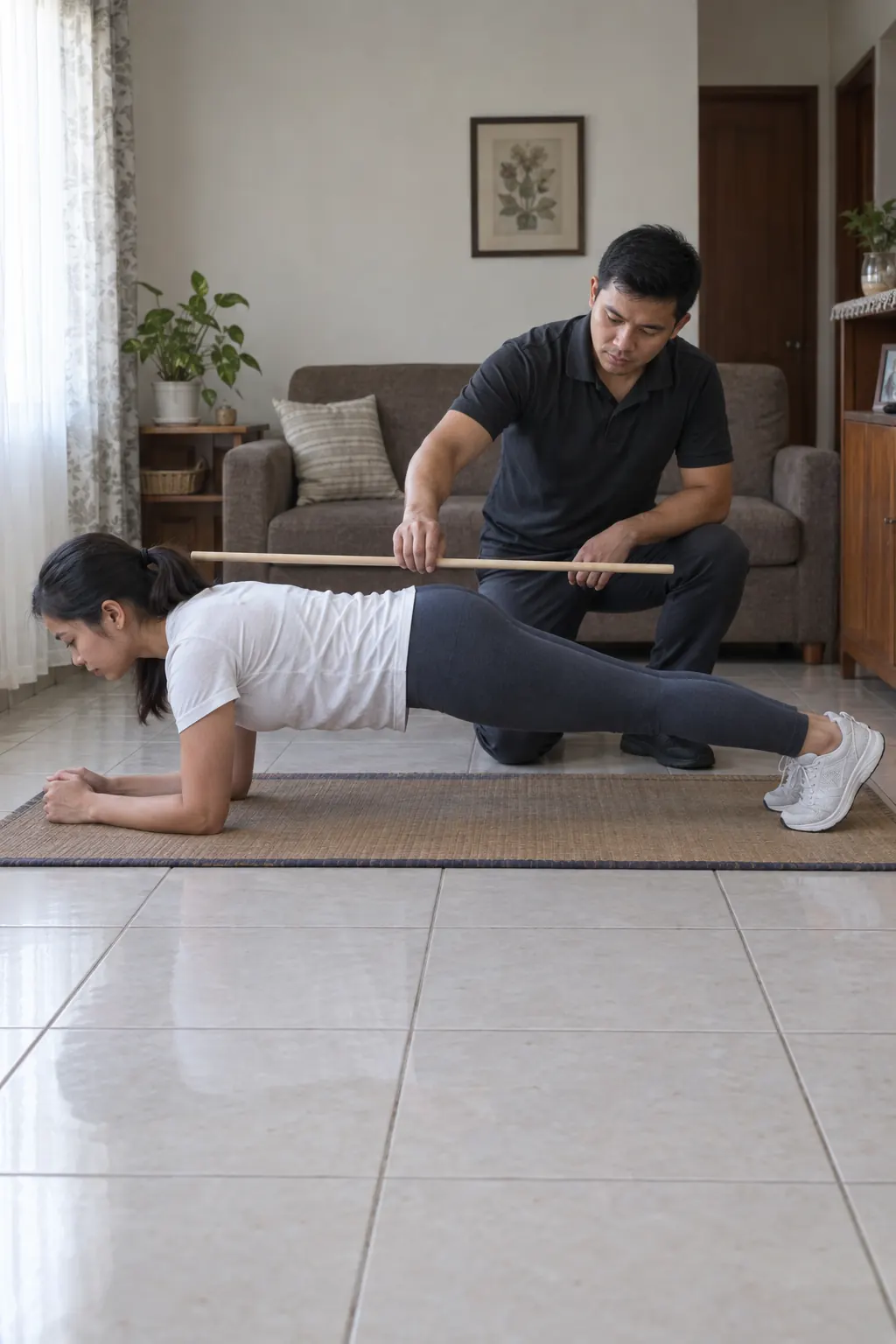
Squeeze the backside and brace the stomach as if someone were about to poke it. Lift the body so it forms one straight line from the back of the head to the heels.
Keep the neck long and look at the floor just ahead of your hands. Breathe normally. Holding your breath makes the hold feel stronger and makes it less useful.
A coach checking a plank often lays a stick along the back: it should touch the head, the upper back and the tailbone at once. The exercise form gallery shows this exact check, with a dowel held above a client’s back in a living room.
The three common faults
Hips sagging towards the floor. The lower back takes the load, which is the opposite of the point. Squeeze the backside harder, or drop to the knee version below.
Hips piked up high. It feels easier because it is. Lower them until the line is straight.
Shoulders creeping up to the ears. Push the floor away through the forearms so the shoulder blades spread.
Easier and harder versions
From the knees. Same position, but with the knees down and the line running from head to knees. This is where most beginners should start, and it is a full plank in its own right.
Incline plank. Forearms on a sturdy bench, the edge of a bed or the kitchen counter. The higher the surface, the easier the hold.
Side plank. On one forearm, feet stacked or the bottom knee down, hips lifted so the body forms a straight line from head to feet. It works the sides of the trunk that the front plank misses.
Plank with a reach. Once the basic hold is steady, lift one hand a few centimetres off the floor without letting the hips rock. This is harder than it sounds.
The same idea on your back. The dead bug trains the trunk to stay still while an arm and the opposite leg move, lying down, which suits anyone whose wrists or shoulders do not yet like a plank.
How long to hold it
Start with holds of ten to twenty seconds, with good form, repeated three or four times with a rest between. Stop each hold the moment the line starts to fail. Add a few seconds a week.
Very long holds add little. Once a clean one-minute plank is easy, a harder version will do more than a two-minute one.
Building it into a week
A plank takes almost no space, so it fits at the end of any session, or on its own in front of the television. Two or three times a week is plenty for a beginner, alongside the squats, pushes and pulls that train the rest of the body, as in our free workout plan for the week. If you like slow floor work, our guide to mat Pilates at home adds six beginner moves for the same mat, and the bird dog is the natural partner to the plank on hands and knees.
Fit Bud’s beginner fitness program starts people who have never trained with exactly this kind of move, at home, with a coach watching the line. If you would like that first check done in your own sala, tell us your town and your goal.