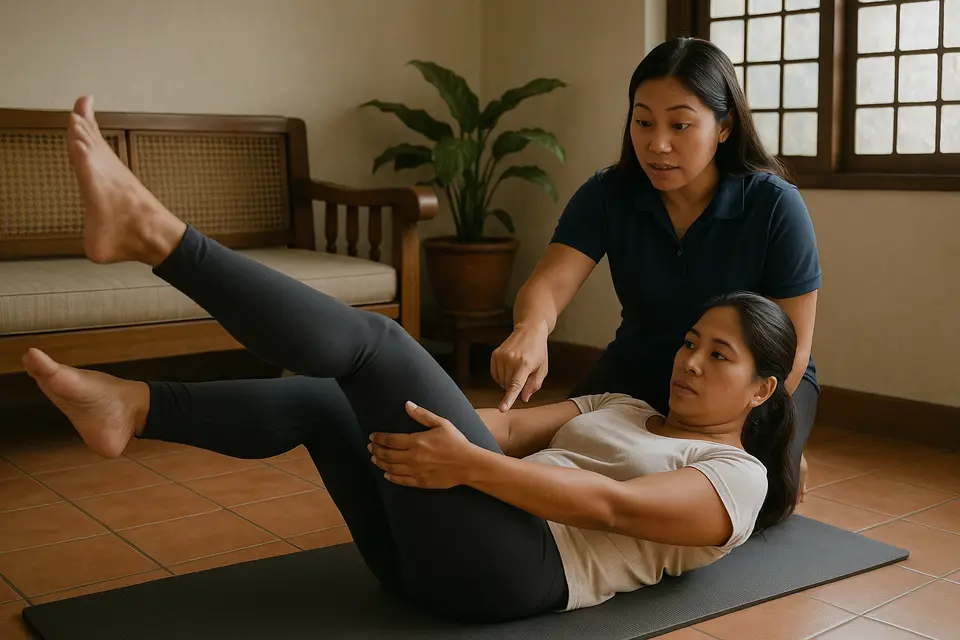
Generated illustration.
Mat Pilates is a series of slow, controlled exercises done lying, sitting or kneeling on a mat, with most of the work coming from the deep muscles of the stomach, back and hips. It needs no machine and very little space, which is why it has become a common way to start exercising at home.
This guide covers six beginner moves you can do on a sala floor. If you are new to exercise in general, Fit Bud’s beginner fitness programme starts with this kind of floor work before anything heavier, with a coach watching your position.
What mat Pilates is
The method comes from Joseph Pilates, who set out 34 mat exercises in his 1945 book Return to Life Through Contrology. Modern classes use simplified versions of many of them. The common thread is control: you move slowly, breathe on purpose, and keep the trunk steady while the arms and legs move.
Mat Pilates or reformer Pilates
Reformer Pilates uses a sliding carriage with springs, so the springs can help you or add resistance. It is taught in studios because the machine is large; our guide to reformer Pilates explains the machine and what a class is like. Mat Pilates uses your own body weight, which makes many moves harder than they look, because nothing helps you hold the position. For a beginner at home, the mat is the practical place to start.
Before you start
- A mat or a folded blanket on a hard floor. Tiles alone are hard on the spine.
- Breathe out as you make the effort, and in as you return.
- Find “imprint”: lying on your back with knees bent, gently draw the lower ribs down so the small of your back rests lightly on the mat. Most beginner moves use this position.
- Go slowly. If you can only do five good repetitions, stop at five.
Six moves for beginners
Do each move 6 to 10 times, rest briefly, and go round twice. That takes about 20 minutes.
1. Pelvic tilt. Lie on your back, knees bent, feet flat. Breathe out and gently roll the lower back into the mat, then breathe in and let it return. This teaches the stomach to control the lower back, and every other move depends on it.
2. Modified hundred. In imprint, lift both feet so the knees are over the hips. Lift the head and shoulders a little and reach the arms along your sides. Pump the arms up and down a few centimetres while you breathe in for five pumps and out for five. Start with 20 to 30 pumps, rather than the full 100. Keep the head down on the mat if your neck strains.
3. Single-leg stretch. Head and shoulders lifted, one knee drawn in towards the chest and the other leg reaching out at a height where your back stays down. Switch legs slowly. If the lower back lifts off the mat, aim the straight leg higher.
4. Bridge. Feet flat, press through the heels and lift the hips until the body is a straight line from shoulders to knees, then lower one vertebra at a time. Our guide to the glute bridge covers the form in detail.
5. Side-lying leg lift. Lie on one side with the hips stacked and the bottom knee bent. Lift the top leg to hip height and lower it slowly without rolling the hips back. Both sides.
6. Swimming, on hands and knees. On all fours, reach one arm forward and the opposite leg back, hold for a breath, and return. This is the beginner form of the Pilates swimming exercise and is close to the bird dog. It trains the back to stay still while the limbs move, the same job the dead bug does lying face up.
Common mistakes
- Holding the breath through the hard part.
- Pulling on the neck in the curled-up moves. Look at your knees and let the stomach lift you.
- Letting the lower back arch off the mat when the legs go out.
- Rushing. In Pilates, slower is harder and better.
Who should check with a doctor first
Ask your doctor or a physiotherapist before starting if you are pregnant or have recently given birth, have back pain that runs down a leg, have osteoporosis (some curling moves may not suit you), or have had recent surgery. After a birth, a gap between the stomach muscles is common; our guide to diastasis recti exercises explains which moves to do first and which to leave for later.
How often to do it
Two or three sessions a week is a good start. Mat Pilates works well alongside walking and strength training, and the World Health Organization’s 2020 guidelines suggest muscle-strengthening activity on two or more days a week. If you already hold a plank, add it at the end of a mat session.
Questions people ask
Is mat Pilates good for beginners? Yes. It starts lying down, needs no equipment and every move has an easier version. Start with short sessions and the simplest forms.
Is mat Pilates different from regular Pilates? Mat Pilates is the original form of the method. “Pilates” in a studio often means the reformer machine. The principles are the same.
What is mat Pilates good for? Core strength, control of the lower back and hips, and posture. It does not replace cardio or heavier strength training, but it supports both.
Can I learn mat Pilates at home? Yes, the beginner moves above are safe for most healthy adults. If you want the classical method taught step by step, look for a certified Pilates instructor.
Getting help at home
A personal trainer is not a Pilates instructor, and Fit Bud does not claim to teach the classical method. What a coach on the beginner fitness programme does is use mat moves like these inside a wider plan, check your position on your own floor, and add strength and walking around them. If that sounds useful, tell us your town and your goal.
Sources
Joseph H. Pilates and William J. Miller, Return to Life Through Contrology, 1945: the 34 original mat exercises. World Health Organization, Guidelines on physical activity and sedentary behaviour, 2020: muscle-strengthening activity on two or more days a week.