Generated illustration.
The bird dog is done on hands and knees: you reach one arm forward and the opposite leg back, hold, and return, without letting the back or hips move. The name comes from the way a hunting dog points, nose forward and one leg back. It needs a mat and nothing else, and it is one of the few exercises that physiotherapists, strength coaches and Pilates teachers all use.
This guide covers what it trains, the form that makes it work, the faults that turn it into a back-arching exercise, and how to make it easier or harder. If you want someone to watch your back while you do it, that is what a coach on Fit Bud’s beginner fitness programme does on your own floor.
What the bird dog trains
- The muscles along the spine. They hold the back still and level while an arm and a leg move away from the body.
- The glutes. The back leg is lifted by the buttock muscle, not by arching the lower back.
- The deep stomach muscles. They stop the hips from rotating and the belly from sagging towards the floor.
- The shoulder. The supporting arm holds the upper body; the reaching arm works the back of the shoulder.
The job it trains is the one the back does all day: staying steady while the limbs do something. It is the face-down partner of the dead bug, which trains the same control lying on the back.
The bird dog is also one of the three exercises the spine researcher Stuart McGill recommends for building a back that tolerates daily life, alongside a modified curl-up and the side plank. That is why it appears in so many programmes for people recovering from low back pain. It is not a cure for anything, and it is not a substitute for seeing someone about pain that will not go away.
How to do a bird dog
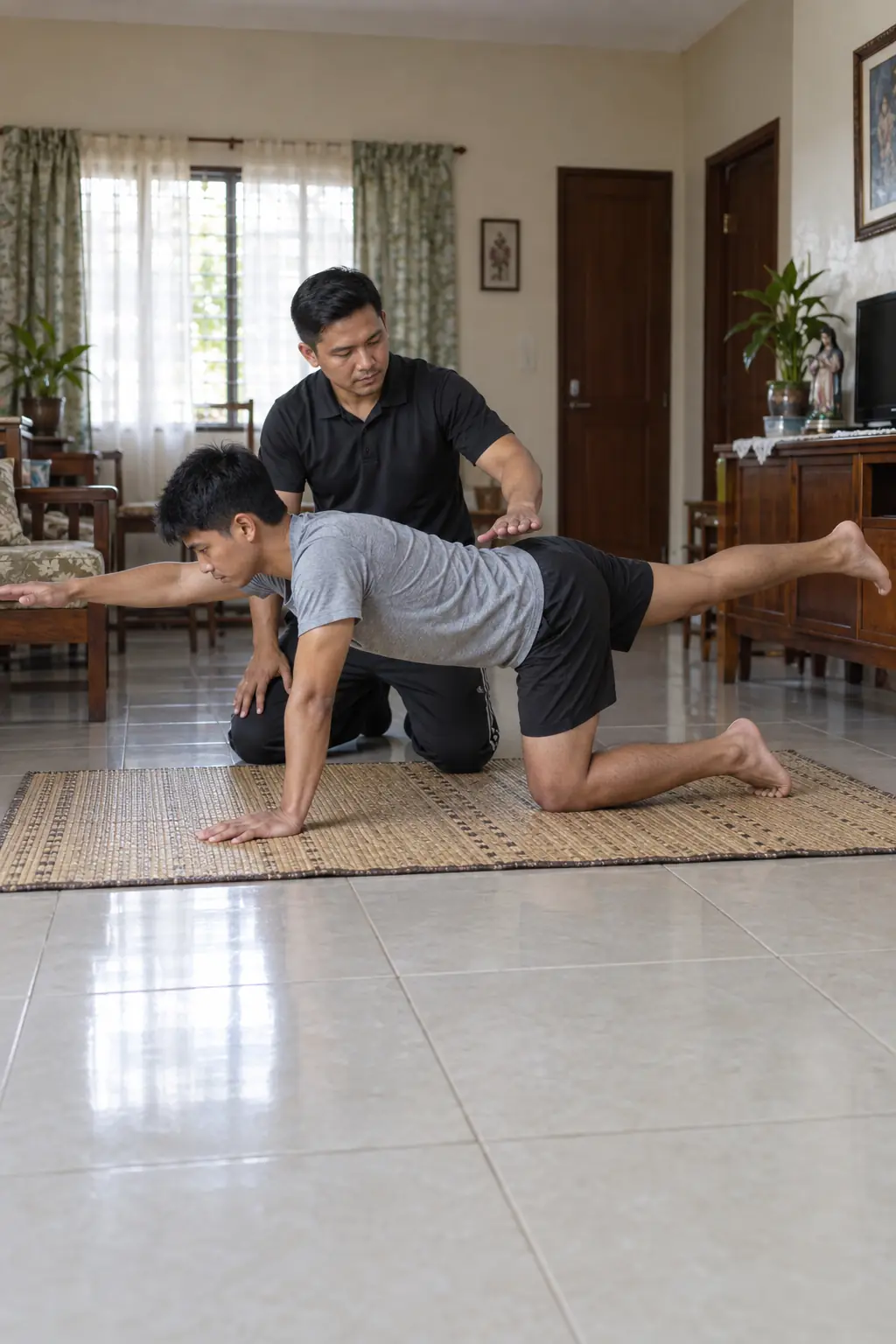
- Kneel on a mat on hands and knees. Hands under the shoulders, knees under the hips, back flat, eyes on the floor a little ahead of the hands. The home workouts gallery shows this tabletop position and the full bird dog in a sala.
- Brace the stomach gently, as if about to be poked, and keep the back exactly where it is.
- Breathe out and reach the right arm forward and the left leg back at the same time, until both are level with the body. Not higher.
- Hold for five to ten seconds. The hips stay square to the floor; the back does not arch; the head stays in line.
- Return slowly to hands and knees, and repeat with the left arm and right leg.
Start with 5 or 6 holds on each side and do two or three sets. The test a coach uses is simple: a hand held flat over the lower back should not feel it move, and a glass of water on the back would stay there.
The faults a coach corrects most
The hips rotate. When the leg lifts, the hip on that side rolls up and the pelvis twists. Lift the leg lower, and think of keeping both hip bones pointing at the floor.
The back arches. The leg goes too high and the lower back dips to let it. The foot should be no higher than the hip.
The head lifts. Looking up arches the neck and the back follows. Eyes stay on the floor.
Rushing. Swinging the arm and leg out and back is momentum. The hold is the exercise.
The supporting hand drifts. Keep the hand under the shoulder and press the floor away so the shoulder blade does not collapse.
Easier versions
- Leg only. Keep both hands on the floor and slide one leg back along the mat, then lift it just off the floor.
- Arm only. Keep both knees down and reach one arm forward.
- Short holds. Two or three seconds, with the focus on a still back.
- Fists, or forearms on a low bench, if the wrists hurt on flat palms. Fold the mat under the knees if they are sore.
Harder versions
- Longer holds. Ten seconds, then fifteen, with the back perfectly still.
- The sweep. From the extended position, bring the elbow and the knee together under the body, then reach out again, without putting them down. Five sweeps each side.
- A band. Loop a light resistance band from the hand to the opposite foot so the reach works against it.
- On a bench. The narrower base makes balance harder. Only once the floor version is clean.
- A small weight in the hand, such as a full water bottle, held with the arm straight.
Add one change at a time. Our guide to progressive overload explains when a move has earned a harder version.
Bird dog for a stiff or sore back
Many people meet the bird dog in physiotherapy. Done slowly, with the back held still, it is one of the better-tolerated exercises for a back that is stiff after sitting, and it teaches the control that squats and carries later depend on. The rules are the same as for anyone: no arching, no twisting, and no pushing into pain.
See a doctor or a physiotherapist first if the pain runs down a leg, if there is numbness or tingling, if it began with an injury, or if it has lasted more than a few weeks. A home coach works alongside that advice and does not replace it.
Who should check first
Ask your doctor before starting if you have a recent back or shoulder injury, recent surgery, or wrist problems that make hands-and-knees positions painful. The bird dog is often fine in pregnancy and is commonly used after birth, but check first; our guides to exercise for pregnant women and diastasis recti exercises cover what comes first in each case.
Where it fits in a week
Near the start of a session, after a few minutes of walking or marching, with the dead bug, the plank and the glute bridge. The hands-and-knees swimming move in our mat Pilates guide is the same exercise under another name. Two or three times a week is plenty, and it fits as well into a session for an older parent, where our guide to strength and balance training for seniors gives the gentler moves around it.
Questions people ask
What does the bird dog exercise work? The muscles along the spine, the glutes, the deep stomach muscles and the shoulders. The point is holding the back still while an arm and a leg move.
Is bird dog good for lower back pain? It is widely used in back rehabilitation because it trains the back to stay steady under load without bending it. Do it slowly and without pain, and see a doctor or physiotherapist about pain that runs down a leg or will not settle.
How many bird dogs should I do? Five or six holds of five to ten seconds on each side, for two or three sets. Build the hold time before the number.
Bird dog or dead bug? Both train the same control, one face down and one face up. Most programmes use both. If the wrists or knees hurt, start with the dead bug.
Why is it called the bird dog? After the pointing stance of a hunting dog: nose forward, one hind leg back, body still.
Having your back watched
The faults in a bird dog are almost impossible to feel and easy for someone else to see, which is why one session with a hand over the lower back usually fixes it. Fit Bud’s beginner fitness programme starts people who have never trained with exactly this kind of floor work, and strength training sessions use it before the loaded moves. If you would like it checked on your own mat, tell us your town and your goal.
Sources
Stuart McGill, Low Back Disorders: Evidence-Based Prevention and Rehabilitation, 3rd edition, Human Kinetics, 2016: the bird dog as one of three core stabilisation exercises, with the modified curl-up and the side bridge, held for short repeated efforts. American Council on Exercise, Exercise Library, “Bird-dog”: a core exercise targeting the abs, back and glutes.