
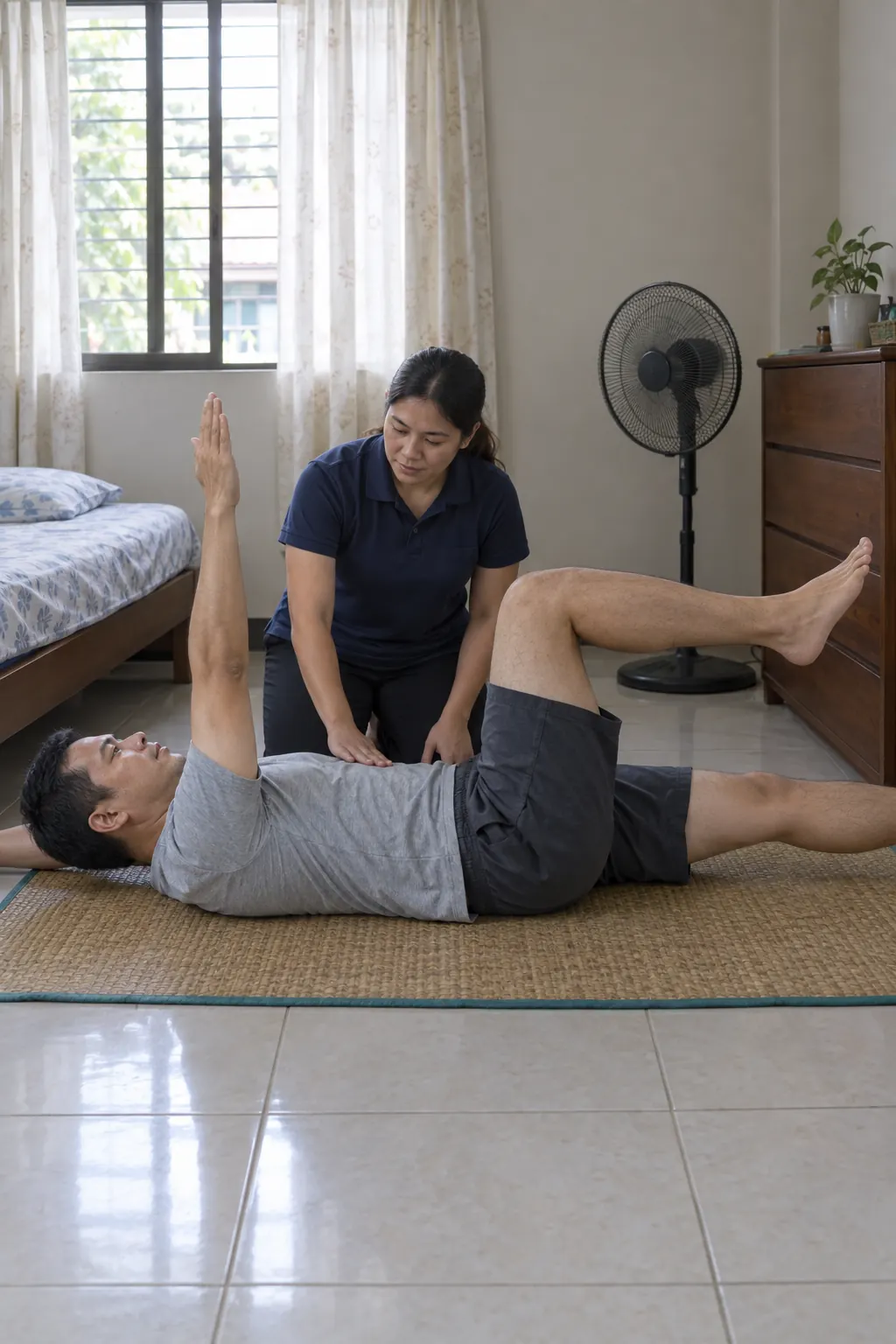
Generated illustration.
The name comes from the position: flat on your back with your arms and legs in the air, like an insect that has rolled over. It looks faintly ridiculous, and it earns its place on a living room floor.
The dead bug trains the stomach muscles to do their real job, which is to keep the trunk steady while the arms and legs move. That is what they do when you carry a sack of rice up the stairs or lift a child into a car seat. It needs a mat or a folded blanket and nothing else.
How to do a dead bug
Lie on your back on a mat. Lift your arms straight up so the hands point at the ceiling. Lift your legs and bend the knees to a right angle, so the shins are level with the floor and the knees sit above the hips.
Press your lower back gently into the mat. You should be able to feel the floor under it, with no gap a hand could slide through.
Breathe out and slowly lower your right arm behind your head and your left leg towards the floor at the same time, straightening the leg as it goes. Stop just above the floor, or sooner if your lower back starts to lift.
Breathe in and bring them back to the start. Then do the left arm and the right leg.
Start with 6 to 8 slow repetitions on each side, rest, and do two or three sets. The home workouts gallery shows the lowered position on a woven mat, with a coach’s hand on the stomach to feel it stay flat.
What it trains
The deep muscles of the stomach and the muscles along the sides of the trunk, working to stop the lower back arching while an arm and a leg move away from you. Unlike a sit-up, the trunk barely moves. The work is in holding still, which is why the dead bug often appears early in programs, beside the plank, the glute bridge and its face-down partner, the bird dog.
Common mistakes
The lower back lifting off the mat. This is the one that matters. The moment the back arches, the exercise has stopped training the stomach and started loading the spine. Make the movement smaller: lower the leg only as far as the back stays down.
Moving too fast. Arms and legs swinging down and bouncing back is momentum. Lower for two or three seconds, return for one or two.
Holding your breath. Breathe out as the arm and leg go away, in as they come back.
Tensing the neck. The head stays resting on the mat and the chin stays slightly tucked.
Making it easier
If the back lifts on every repetition, try these first:
Legs only. Keep both hands on the floor by your sides, or pressed into your thighs, and lower one heel at a time to tap the floor with the knee still bent.
Bent-leg taps. Keep the knee bent the whole way and just tap the heel down, rather than straightening the leg.
Smaller range. Lower the arm and leg only a quarter of the way.
Making it harder
Once three sets of ten slow, clean repetitions on each side feel easy:
A pause at the bottom. Hold the lowered position for two or three seconds without letting the back lift.
A light weight in the hands. A small dumbbell or a full water bottle held in each hand.
A band. Hold a resistance band anchored behind your head, so the arms work against it the whole time. The resistance band gallery shows how a band is anchored and held for rows, presses and bridges at home.
Who should check with a doctor first
Anyone with a back injury or recent surgery, and anyone who is pregnant or has given birth recently. Lying flat on the back is often limited after the first trimester, and after a birth the stomach muscles may still be separated; our guide to diastasis recti exercises after birth explains the gentler work that comes first.
Where it fits in a week
The dead bug belongs near the start of a session, after a few minutes of walking or marching on the spot, or on its own two or three times a week. A steady trunk is what squats, deadlifts and carrying lean on, and a version of the same idea runs through mat Pilates for beginners, and Fit Bud’s strength training page explains how coaching at home builds towards them. If you would like a coach to check your form on your own floor, tell us your town and your goal.