Generated illustration.
Exercise is physical activity that is planned and repeated to keep or improve some part of fitness. That definition matters, because sweeping the yard, carrying the groceries and walking to the sari-sari store are all physical activity and all good for you, but they do not improve the body on purpose. Exercise does.
There are four types, and most people only do one. This guide explains what each one does, how much of each is recommended, and how to put them together without turning your week into a timetable.
The four types
Health bodies group exercise into endurance, strength, balance and flexibility. The names are from the United States National Institute on Aging, which uses them for adults of every age, and the amounts below are from the World Health Organization’s 2020 guidelines.
Endurance, also called aerobic exercise
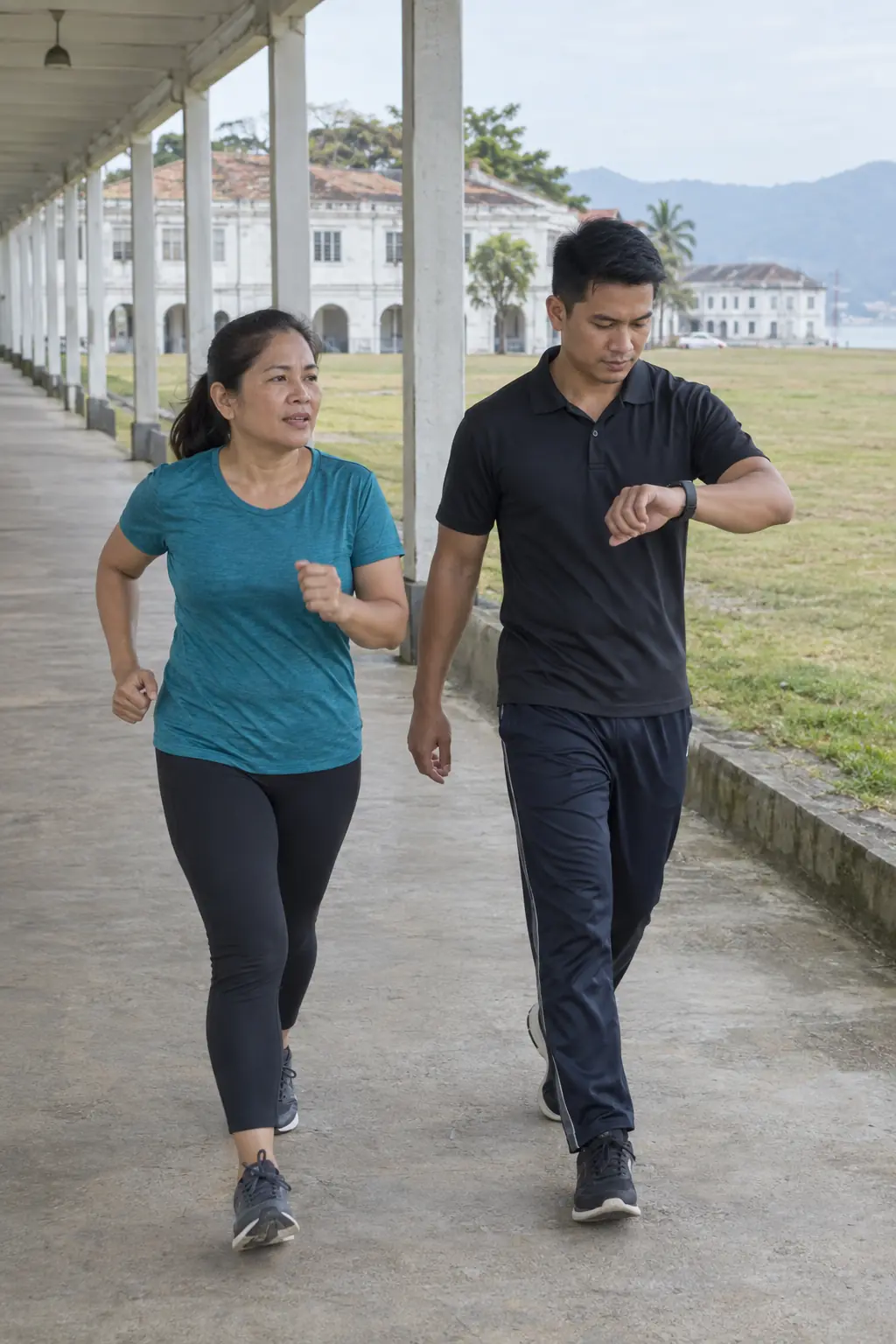
Anything that raises your breathing and heart rate and keeps them up: brisk walking, jogging, cycling, swimming, dancing, a basketball game at the court, a Zumba class at the barangay hall.
It trains the heart, the lungs and the blood vessels, and it is the type most of the research on long-term health is about. It is also the one that helps most with the stairs, the commute and keeping up with the children.
The simplest test of intensity is talking. At a moderate pace you can talk but not sing. At a vigorous pace you can say a few words at a time.
Strength, also called resistance training
Working the muscles against a load until they tire: bodyweight squats and push-ups, bands, dumbbells, kettlebells, a bar at the gym, or carrying something heavy for distance.
It builds and keeps muscle and bone, which both decline with age from the thirties onward unless they are asked to work. Stronger muscles make every daily task cheaper, from lifting a sack of rice to getting out of a low chair. Strength training is the type most people skip, especially women and older adults, and it is the one Fit Bud’s coaches spend the most time on. Our guide to strength training at home with no equipment is the place to begin.
Balance
Exercises that challenge you to stay upright: standing on one leg while brushing your teeth, walking heel to toe along a line of tiles, tai chi, the sit-to-stand from a chair, stepping over and around things.
Balance work matters most after 60, because a fall is one of the main ways an older adult loses independence, and the WHO recommends it specifically for that age group. It also matters for anyone recovering from a long period of inactivity. Our guide to strength and balance training for seniors has the moves.
Flexibility and mobility
Moving the joints through their range and holding gentle stretches: reaching for the toes, the hip stretch from a kneeling position, shoulder circles, a slow cat and cow on the mat.
Flexibility keeps the range of motion that sitting all day takes away. It will not make you stronger or fitter on its own, and the old habit of long stretches before a workout has been replaced by moving warm-ups, as our guide to stretching before a workout explains. The time for held stretches is after a session, or on its own in the evening. Slow floor work such as mat Pilates covers flexibility and trunk strength together.
How much of each
| Type | WHO recommendation for adults | What that looks like |
|---|---|---|
| Endurance | 150 to 300 minutes a week at moderate intensity, or 75 to 150 at vigorous, or a mix | A 30-minute brisk walk on five days |
| Strength | Two or more days a week, all the major muscle groups | Two or three full-body sessions |
| Balance | Three or more days a week for adults 65 and over, as part of varied activity | A few minutes with the chair or the counter most days |
| Flexibility | No minimum set by the WHO | Five to ten minutes after sessions, or an evening on the mat |
The guidelines also say that some activity is better than none, and that people who do less than the recommended amount still gain from doing a little more. If 150 minutes sounds far away, 30 does not.
These are targets for healthy adults. Pregnant and postpartum women are advised at least 150 minutes of moderate activity a week with their doctor’s clearance, and our guide to exercise for pregnant women at home covers what changes. People with a medical condition should ask their doctor what applies to them.
What type should you start with
It depends on where you are.
You have not exercised in years. Start with walking and two short strength sessions a week. Walking needs nothing, and strength work stops the aches that come from a body that has not been loaded. The free weekly workout plan puts the two together.
You walk or run already. Add strength. Runners and walkers who lift tend to stay injury-free longer, and it fills the one gap in their week.
You lift already. Add endurance work on the days between. Twenty minutes on a bike or a brisk walk is enough to start, and it helps recovery between strength days.
You are over 60, or looking after a parent who is. Balance and strength come first. Both can be done holding a chair. Endurance work is a daily walk at whatever pace is comfortable.
You sit all day and everything feels stiff. A moving warm-up each morning and a few held stretches in the evening, with strength work twice a week so the muscles that hold you up stop being the problem.
A week with all four
| Day | Session | Types covered |
|---|---|---|
| Monday | Full-body strength, 30 minutes, then five minutes of stretches | Strength, flexibility |
| Tuesday | Brisk walk, 30 minutes | Endurance |
| Wednesday | Full-body strength with single-leg moves such as lunges and step-ups | Strength, balance |
| Thursday | Walk, swim or bike, 30 minutes | Endurance |
| Friday | Full-body strength, then stretches | Strength, flexibility |
| Saturday | Basketball, a long walk, a dance class, anything you enjoy | Endurance, balance |
| Sunday | Rest, or a slow mat session | Flexibility |
That week meets the WHO targets for strength and gets close to them for endurance, with balance work built into the lunges and step-ups rather than added as a separate chore. Nothing in it needs a gym. Every session ends with a few minutes of cool down exercises, which is where the flexibility work mostly happens.
Exercising in the Philippines
The heat shapes all of this. Endurance work outdoors belongs in the early morning or after dark for most of the year, and the covered court, the mall before the shops open, and the sala with the fan on all count when the weather does not cooperate. Strength work indoors is the easiest type to keep going in the rainy season, which is one reason to build the habit at home. Our guide to training in the heat covers water, timing and the signs to stop.
Common mistakes
- Doing only one type. Hours of walking with no strength work, or lifting with no endurance work, leaves a gap that shows up later.
- Treating housework or a long day on your feet as exercise. It is activity and it counts for health, but it does not progress, so it does not build fitness on its own.
- Starting at the recommended amount instead of building towards it.
- Stretching cold before a session and skipping the moving warm-up.
- Stopping balance work because it feels too easy or too silly. It is neither after 60.
When to check with a doctor first
Most healthy adults can start walking and light strength work without a medical check. Ask your doctor first if you have a heart condition, chest pain, high blood pressure that is not controlled, diabetes, a recent operation, dizziness or fainting, or a joint or back problem that limits what you can do. If exercise causes chest pain, severe breathlessness or dizziness, stop and seek medical help. For joint pain that persists after a session, see a doctor or a physiotherapist rather than pushing through.
Questions people ask
What are the 4 types of exercise? Endurance, which raises the heart rate; strength, which loads the muscles; balance, which trains you to stay upright; and flexibility, which keeps the joints moving through their range. Each does something the others do not.
What is the best exercise? The one you will do three times a week for a year. Within that, a mix of brisk walking and full-body strength work covers most of what the body needs.
Is walking enough exercise? Walking covers the endurance type well and is the best place for most people to start. It does not build muscle or bone, so adding two short strength sessions a week fills the gap.
How many minutes of exercise a day do I need? The WHO adult target works out at about 30 minutes of moderate activity on five days, plus strength work on two of them. Less than that still helps, and more than that helps further up to about 300 minutes a week.
How long before I notice a difference? Most people feel the stairs and the commute get easier within a few weeks of regular walking, and notice they are lifting more within a month of strength work. Visible changes take longer and vary from person to person. No honest coach promises a date.
Getting someone to put it together for you
Knowing the four types is the easy part. Fitting them into a week with a commute, a household and the heat, and knowing which moves suit your body, is what a coach does at a first session. Fit Bud’s beginner fitness program starts people who have never trained, at home or wherever suits, and fitness for seniors covers the balance and strength work for parents and grandparents. To start, tell us your town and your goal.
Sources
World Health Organization, Guidelines on physical activity and sedentary behaviour, 2020: adult aerobic and muscle-strengthening targets, the balance recommendation for adults 65 and over, the guidance for pregnant and postpartum women, and the statement that some activity is better than none. United States National Institute on Aging, “Four Types of Exercise Can Improve Your Health and Physical Ability”: the endurance, strength, balance and flexibility grouping.