Generated illustration.
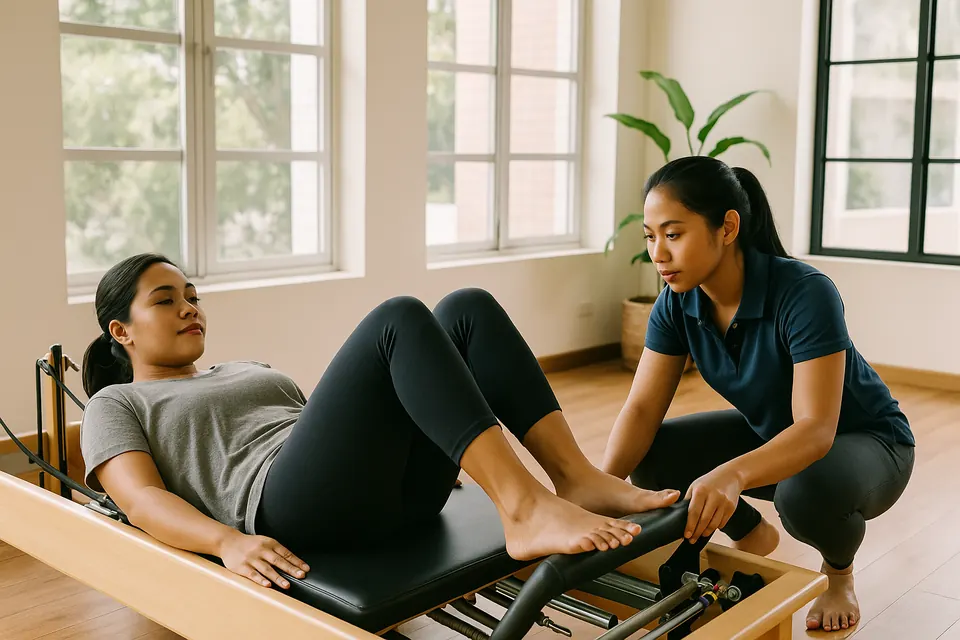
Reformer Pilates is Pilates done on a machine called a reformer: a low bed with a carriage that slides along rails, springs that make the sliding easier or harder, a bar for the feet, and straps for the hands or feet. It is the form of Pilates most studios teach, and it is the reason “Pilates” in a city now usually means a booked class rather than a mat on the floor.
This guide explains what the machine does, what a first class is like, who it suits, and how much of the same work a mat at home can cover. Fit Bud does not teach reformer Pilates and does not own a reformer. What a coach on the beginner fitness programme can do is build the mat version into a plan at your home, which is where most people in Olongapo, Subic and the rest of Zambales will end up doing it anyway.
What the reformer is
Joseph Pilates designed the reformer in the early twentieth century, alongside the floor exercises he later published as a mat method. The machine has five parts that matter:
- The carriage. A padded platform that slides back and forth on rails inside the frame.
- The springs. Four or five springs of different strengths hook between the carriage and the frame. More springs, or heavier ones, make the carriage harder to push away.
- The foot bar. A padded bar at one end that you push against with the feet or hands.
- The straps. Long straps with loops or handles, attached to pulleys at the other end, for the hands or feet.
- The headrest and shoulder blocks. They keep you in place when you push the carriage with your legs.
That is the whole machine. Everything a class does is a way of moving the carriage against the springs with control, or of holding the carriage still while a limb moves.
What the springs do
The springs are what make the reformer different from a mat. Heavier springs add resistance, so pushing the carriage with the legs becomes a leg press and pulling the straps becomes a rowing movement. Lighter springs give less support, which makes some balancing and stabilising moves harder, because the carriage slides away if you lose control.
For a beginner the springs are mostly a help. They support the body weight, guide the movement along one track and give feedback: if the carriage jerks or bangs home, you moved too fast or let go of control. On a mat, nothing tells you that.
What a first class is like
Most studio classes run about 50 minutes, in a small group with one instructor, each person on their own machine. A typical beginner class runs through:
- Footwork. Lying on the back, feet on the bar, pushing the carriage away and back in several foot positions. It warms the legs and teaches the control the rest of the class needs.
- The hundred. The same breathing exercise as on a mat, with the arms pulling the straps.
- Leg circles and frog in the straps. Feet in the loops, drawing circles and bending and straightening against the springs.
- Arm work. Rows, presses and circles with the hands in the straps.
- Kneeling and standing work. Lunges, side splits and knee stretches with the carriage moving under you.
- A stretch to finish.
The instructor sets the springs for each exercise and for each person. The first class is usually awkward, because you are learning to control a moving platform, and that is normal. Many studios run an introductory class for exactly this reason.
What reformer Pilates is good for
- Controlled strength through a full range. The springs load the movement from start to finish, including the slow return, which is where muscles often get the most work.
- The trunk, hips and shoulders. Almost every exercise asks the stomach and back to hold still while the limbs push or pull.
- Joints that dislike impact. You are lying, sitting or kneeling on a padded carriage, so knees, hips and backs are loaded without jumping or heavy weights.
- Posture and the small muscles. The straps and the sliding carriage catch wobbles that a barbell or a machine at the gym does not.
What it is not: a cardio session, a weight-loss method on its own, or a replacement for heavier strength work if your goal is building muscle. It supports those things. It does not replace them.
Reformer Pilates or mat Pilates
| Reformer | Mat | |
|---|---|---|
| Equipment | The machine, at a studio | A mat on any floor |
| Resistance | Springs, adjustable | Your own body weight |
| For a beginner | Supported and guided; the springs help | Harder than it looks; nothing helps you hold position |
| Feedback | The carriage tells you when control is lost | A coach or a mirror |
| Where you can do it | Where there is a studio | Your sala, a condo gym, a clubhouse |
| Time cost | The class plus the trip | Twenty minutes, no trip |
The method is the same on both. Joseph Pilates set out 34 mat exercises in 1945 and built the apparatus to help people do that work with support. The mat is where the method started, and most reformer exercises have a mat version. Our guide to mat Pilates at home for beginners gives six of them.
Is reformer Pilates hard for beginners
Not especially, as long as you start in a beginner class. The first session is more awkward than hard: you learn where to put your feet, how to breathe and how to move the carriage without a bang. The springs do a lot of the supporting in the early weeks. The move that catches most beginners out is anything standing or kneeling on the carriage, which is why those come later.
If you have never exercised at all, a few weeks of walking and simple floor work first makes the first class easier. The plank, the dead bug and the glute bridge teach the same trunk control the reformer asks for.
Who should check with a doctor first
Tell the studio and ask your doctor or a physiotherapist before your first class if you are pregnant or have recently given birth, have osteoporosis, have had a joint replacement or recent surgery, have back pain that runs down a leg, or have a heart condition. Reformer work is often used in rehabilitation, but it should be set up by someone who knows your case. After a birth, our guide to diastasis recti exercises explains what comes first.
Doing the work at home without the machine
Studios cluster in the cities. If the nearest reformer is a long drive from your home, a mat and a resistance band cover more of the method than people expect.
- Footwork becomes bodyweight squats and bridges, with the feet in the same positions.
- Leg circles and frog become the same movements lying on the back with a band around the feet, held in the hands.
- Straps arm work becomes band rows, presses and pull-aparts, anchored to a door or a gate. The resistance band gallery shows how a band is anchored at home.
- Kneeling and standing work becomes lunges and split squats, slow, with a chair for balance.
- The hundred is the same on a mat.
A coach brings the bands, checks the position of the lower back and hips, and adds the walking and strength work that Pilates on its own does not cover.
Questions people ask
What is reformer Pilates actually good for? Controlled strength through a full range of movement, the trunk and hips, posture, and loading the joints without impact. It is not cardio and it does not build large muscles on its own.
Is reformer Pilates difficult for beginners? The first class is awkward rather than hard. The springs support you, and beginner classes start with footwork lying down. Standing and kneeling exercises come later.
What is the Pilates reformer? A low frame with a sliding carriage, springs for resistance, a foot bar and straps. The exercises move the carriage against the springs with control, or hold it still while a limb moves.
What is the difference between reformer Pilates and regular Pilates? Regular, or mat, Pilates uses only body weight on a mat. Reformer Pilates does similar exercises on the machine, where the springs can support a beginner or add resistance. The principles are the same.
Can you do reformer Pilates at home? Only with a reformer. Home machines exist but take up the space of a single bed. Most of the exercises have a mat or band version that works on a sala floor.
How often should you do reformer Pilates? Two or three sessions a week is typical, and the World Health Organization’s 2020 guidelines ask for muscle-strengthening activity on two or more days a week, which Pilates counts towards.
Getting the mat version set up at home
A personal trainer is not a Pilates instructor, and Fit Bud does not claim to teach the classical method on a reformer or anywhere else. What a coach on the beginner fitness programme does is use the mat and band versions of this work inside a wider plan, check your position on your own floor, and add strength and walking around it. If you have been meaning to try Pilates and the studio is too far, tell us your town and your goal.
Sources
Joseph H. Pilates and William J. Miller, Return to Life Through Contrology, 1945: the 34 original mat exercises and the principles the apparatus work shares with them. World Health Organization, Guidelines on physical activity and sedentary behaviour, 2020: muscle-strengthening activity on two or more days a week.