Generated illustration.
Mountain climbers are a plank with running legs: hands on the floor under the shoulders, body in a straight line, and the knees driven in towards the chest one after the other. They need a mat and about two metres of floor, which is why they turn up in so many home workouts, and they are one of the exercises people most often do with poor form.
This guide covers what the move trains, the form that keeps the wrists and lower back happy, easier and harder versions, and how many to do. If you want someone to watch the hips while you do them, that is a normal part of Fit Bud’s sports conditioning sessions at home or on a court.
What mountain climbers work
- Shoulders and arms. They hold the whole upper body still, as in a plank.
- Stomach and trunk. The deep muscles keep the hips level and the back flat while the legs move. This is the main point of the exercise.
- Hip flexors and legs. The front of the hips and thighs drive each knee in; the calves and feet push off.
- Heart and lungs. Done fast, the heart rate climbs quickly, which is why the move appears in circuits and conditioning sessions.
So it is part strength, part cardio. It does not burn fat from the stomach specifically. No exercise does that; our guide to visceral fat explains what moves belly fat and what does not.
How to do mountain climbers
- Start in a high plank: hands flat on the mat directly under the shoulders, fingers spread, arms straight, feet hip-width apart. Body in one line from head to heels.
- Brace the stomach as if someone were about to poke it, and set the shoulders down away from the ears.
- Drive the right knee in towards the chest, foot off the floor, without lifting the hips.
- Return the right foot to the start and drive the left knee in.
- Keep alternating. Start slowly, at a pace where the hips stay level and the hands stay under the shoulders, and only speed up once that is easy.
Breathe steadily through the set. Holding your breath makes the trunk stiff for a few reps and then leaves you gasping.
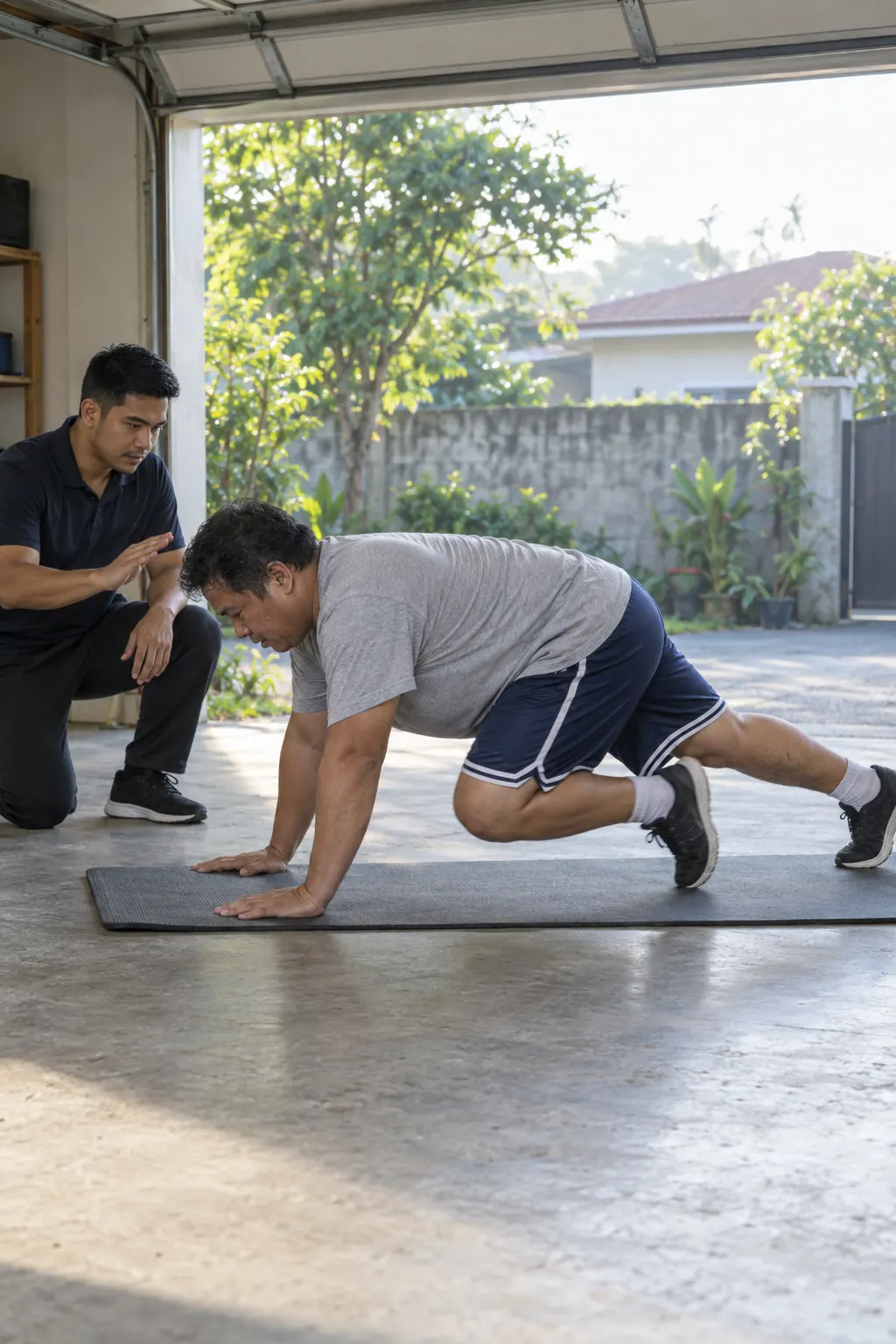
The home workouts gallery shows the move on a mat in an open garage, with a coach kneeling beside it to call the rhythm.
The faults a coach corrects most
Hips up in the air. The most common one. The body makes an upside-down V, the stomach stops working and the move becomes much easier. Keep the hips level with the shoulders.
Hips sagging. The opposite fault, usually when tired. The lower back arches and starts to take the load. Stop the set when the hips drop.
Hands drifting in front of the shoulders. This is what hurts the wrists. Set the hands under the shoulders and keep them there.
Bouncing both feet. Hopping the feet in and out together is a different exercise and much harder on the knees and lower back. One leg moves at a time.
Going fast before going well. Speed is the last thing to add. Form first, then range, then pace.
Easier versions
- Hands on a bench, a low wall or the second stair. Raising the hands takes weight off the shoulders and wrists and makes the trunk easier to hold.
- Slow and paused. Bring one knee in, pause for a second, return it, then the other. No running yet.
- Shorter sets. Ten seconds with good form beats thirty seconds with the hips in the air.
- Fists or dumbbells under the hands if flat palms hurt the wrists.
Harder versions
- Faster. Once the slow version is clean, run the legs. The hips stay level.
- Cross-body. Drive the right knee towards the left elbow and the left knee towards the right elbow. More work for the sides of the trunk.
- Sliding. A rag or a folded towel under each foot on a tiled floor lets the feet slide instead of lift, which keeps the stomach working the whole time.
- Feet raised. Feet on a low step or the first stair puts more weight on the shoulders and arms.
- Mixed with push-ups. Ten climbers, one push-up, repeat. A circuit finisher.
How many to do
Count by time rather than reps.
| Level | Work | Rest | Rounds |
|---|---|---|---|
| Beginner | 15 to 20 seconds, slow | 40 seconds | 3 |
| Some training | 30 seconds at a steady pace | 30 seconds | 3 or 4 |
| Conditioning | 40 seconds fast | 20 seconds | 4 to 6 |
Stop every set the moment the hips rise or sag, whatever the clock says. Add five seconds a week, not thirty. Our guide to progressive overload explains how to judge when to add more.
Where they fit in a week
Slow mountain climbers are a good last move in a warm-up, after the marching and squats in our ten-minute warm-up. Fast ones belong in the middle or at the end of a session, in a circuit with squats, push-ups and lunges, two or three times a week. For basketball players, they are one of the few conditioning moves that work at home between court days; our basketball conditioning drills cover the rest. Whatever the session, finish with a few minutes of cool down exercises.
In the heat, remember that a fast set raises body temperature quickly. Train early, keep water beside the mat, and read our guide to training in the Philippine heat for the signs to stop.
Who should check first
Ask a doctor or a physiotherapist before adding mountain climbers if you have wrist, shoulder or lower back pain, a hernia, or a heart condition that limits hard effort. If you are pregnant, the face-down position and the fast pace are usually not suitable after the first trimester; our guide to exercise for pregnant women has the moves that are. If you have recently given birth, start with the gentler trunk work in our diastasis recti guide first.
Questions people ask
What do mountain climbers work? The shoulders and arms, which hold the body up; the stomach and trunk, which keep the hips level; and the hip flexors and legs, which drive the knees in. Done fast, they also work the heart and lungs.
Do mountain climbers burn belly fat? They raise the heart rate and build the trunk, but no exercise removes fat from one place. Fat loss comes from the whole week of training and food, and stomach fat goes with the rest.
How many mountain climbers should I do? Count by time: three sets of 15 to 20 slow seconds for a beginner, building to four to six sets of 40 seconds for conditioning. Stop any set when the hips rise or sag.
Are mountain climbers cardio or strength? Both. Slowly, they are a moving plank that trains the trunk and shoulders. Fast, they are a cardio move. Which one you get depends on the pace.
Why do my wrists hurt doing mountain climbers? Usually because the hands have drifted forward of the shoulders, or because the wrists are not used to the load. Set the hands under the shoulders, try fists or raise the hands onto a bench.
Having the hips checked
The fault in a mountain climber is hard to feel and easy to see, which is why one session with someone watching fixes it. Fit Bud’s sports conditioning sessions use climbers in circuits for players, and the beginner fitness programme introduces them slowly after the plank. If you would like your form checked on your own floor or court, tell us your town and your goal.
Sources
American Council on Exercise, Exercise Library, “Mountain Climbers”: a core and full-body exercise targeting the abs, hips, legs and shoulders. World Health Organization, Guidelines on physical activity and sedentary behaviour, 2020: 150 to 300 minutes of moderate or 75 to 150 minutes of vigorous activity a week, and muscle-strengthening activity on two or more days.